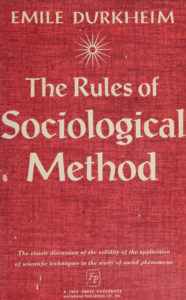
“One of Emile Durkheim’s chief works, The Rules of Sociological Method raises two controversial issues of cardinal importance for all sciences directly concern with human relationships—whether economic, political, or genetic.
The first issue spotlighted is the genuine distinction between the natural and the social sciences. Durkheim reveals that the methods use in the natural sciences are, nevertheless, valid within the social field.
Secondly, he shows how attempts are being made to absorb the social sciences into an enlarged psychology. Against this tendency Durkheim points out that social phenomena, ‘far from being the product of the individual’s own ideas or will, opinion or caprice… have a constraining influence upon the individual and even upon a aggregate of these individuals’.”
This is one of the briefest works of Émile Durkheim (1858–1917), professor of social science at the University of Bordeaux and later professor of sociology and education at the University of Paris, as well as editor-in-chief of L’Année sociologique. Despite its brevity, it is also one of his most important contributions.
There are few sociological writers, not only in France but internationally, of greater significance than Durkheim. His study on suicide (1897) can rightly be placed alongside the works of Charles Booth, Flexner, and W. I. Thomas, as well as other efforts to analyze social structure, the disturbances affecting the body politic, and the factors that determine such disruptions.
His Division du travail social (1893) played a major role in shaping the solidarist school of political philosophy and left a profound mark on the theory of law, particularly as developed by authorities such as the late Professor Léon Duguit. In this work, Durkheim, like Marx, developed ideas previously explored by Adam Smith.
Les règles de la méthode sociologique (1895) is a treatise that raises many of the theoretical problems fundamental to the study of human organization. It stands as a classic in both sociology and the methodology of political science.
The work constitutes an admirable introduction to these fields, not only because of the soundness of its general design, but also because the weaknesses of this masterful statement serve as important warnings to the student.