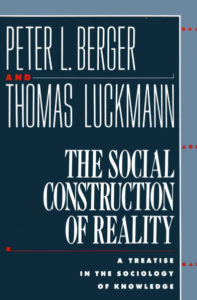
“The basic contentions of the argument of this book are implicit in its title and sub-title, namely, that reality is socially constructed and that the sociology of knowledge must analyse the process in which this occurs. The key terms in these contentions are ‘reality’ and ‘knowledge’, terms that are not only current in everyday speech, but that have behind them a long history of philosophical inquiry. We need not enter here into a discussion of the semantic intricacies of either the everyday or the philosophical usage of these terms. It will be enough, for our purposes, to define ‘reality’ as a quality appertaining to phenomena that we recognize as having a being independent of our own volition (we cannot ‘wish them away’), and to define ‘knowledge’ as the certainty that phenomena are real and that they possess specific characteristics.”
Sociological interest in questions of'reality' and 'knowledge' is thus initially justified by the fact of their social relativity. What is 'real' to a Tibetan monk may not be 'real' to an American businessman. The 'knowledge' of the criminal differs from the 'knowledge' of the criminologist. It follows that specific. agglomerations of 'reality' and 'knowledge' pertain to specific. social contexts, and that these relationships will have to be included in an adequate sociological analysis of these contexts. The need for a 'sociology of knowledge' is thus already given with the observable differences between societies in terms of what is taken for granted as 'knowledge' in them. Beyond this, however, a discipline calling itself by this name will have to concern itself with the general ways by which 'realities' are taken as 'known' in human societies. In other words, a 'sociology of knowledge' will have to deal not only with the empirical variety of 'knowledge' in human societies but also with the processes by which any body of 'knowledge' comes to be socially established as 'reality'.
It is our contention, then, that the sociology of knowledge must concern itself with whatever passes for 'knowledge' in a society, regardless of the ultimate validity or invalidity (by whatever criteria) of such 'knowledge'. And in so far as all human 'knowledge' is developed, transmitted and maintained in social situations, the sociology of knowledge must seek to understand the processes by which this is done in such a way that a taken-for-granted 'reality' congeals for the man in the street. In other words, we contend that the sociology of knowledge is concerned with the analysis of the social construction of reality.
| Title | The Social Construction of Reality |
|---|---|
| Subtitle | A Treatise in the Sociology of Knowledge |
| Autor | Peter Berger and Thomas Luckmann |
| Publisher | Penguin Books |
| Year | 1991 |
| Pages | 249 |
| Country | United States of America |
| ISBN | 0140600019 |
| Format | |
| Filesize | 4.4 MB |
| URL | Peter Berger and Thomas Luckmann The Social Construction of Reality PDF |