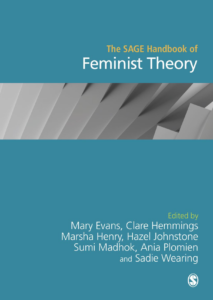
Handbook of Feminist Theory

feminist theory sociology handbook

Overview

At no point in recorded history has there been an absence of intense, and heated, discussion about the subject of how to conduct relations between women and men. Feminist Theory provides a comprehensive guide to these omnipresent issues and debates, mapping the present and future of thinking about feminist theory

Publisher Sage
Year 2014
Pages 681
Filesize 7.9 MB
Format PDF

Summary

This Handbook on Feminist Theory attests to the richness of feminist theory in the second decade of the twenty-first century, across continents and academic disciplines. Its five sections have been edited by Clare Hemmings, Marsha Henry, Sumi Madhok, Ania Plomien and Sadie Wearing, together with Hazel Johnstone, editorial manager of the collection at the Gender Institute of the London School of Economics. The sections bring together essays on diverse subjects by writers from across the globe, united by the conviction that feminist theory offers important and radical possibilities for understanding many of the major intellectual and social issues of the twenty-first century.

A central characteristic of this Handbook is the recognition that the concerns of feminist theory extend across subjects, issues and locations. Feminist theory does not exist within narrow perimeters of concern or engagement; its impact is evident both within and beyond the academy. Gender relations, as the subject matter of feminist theory, are now an explicit and pivotal aspect of the contemporary world.

(…) It is in the light of these, and other, cases—where a ‘natural’ order of gender is asserted and legitimated through various forms of quasi-rational argument—that the need for feminist theory becomes particularly apparent. It is also in such cases that the theoretical acquires its most valuable identity: not as an exercise in semantics or an intervention in obscure debate, but as a practice that unites passionate and informed rationality with the pursuit of goals beyond the immediate interests of any particular individual. In this sense, feminist theory—despite attempts to extend the meaning of the term ‘feminist’ to contexts of rampant self-enrichment—has at its core a commitment to both the identification and the transformation of the ideas that regulate and enforce gender inequality. This positions feminist theory as a genuinely transcendent form of knowledge, one that speaks to individual cases, whether they concern development policies or Hollywood films, while doing so through a dialectical engagement of practice and reflection that connects people, circumstances, and understanding.

Contents

  • PART I. Epistemology and Marginality
    • Feminist Epistemology and the Politics of Knowledge: Questions of Marginality — Lorraine Code
    • Natural Others? On Nature, Culture and Knowledge — Astrida Neimanis
    • Feminist Auto/Biography — Gayle Letherby
    • Power in Feminist Research Processes — Sabine Grenz
    • Women’s ‘Lived Experience’: Feminism and Phenomenology from Simone de Beauvoir to the Present — Sonia Kruks
    • What do Women Want? Feminist Epistemology and Psychoanalytic Theory — Kirsten Campbell
    • Entangled Subjects: Feminism, Religion and the Obligation to Alterity — Sîan Hawthorne
    • Religion, Feminist Theory and Epistemology — Mary Evans
  • PART II. Literary, Visual and Cultural Representation
    • What Stories Make Worlds, What Worlds Make Stories: Margaret Atwood’s Oryx and Crake — Sam McBean
    • On Maternal Listening: Experiments in Sound and the Mother–Daughter Relation in Todd Haynes’ Mildred Pierce — Amber Jacobs
    • The Space of a Movement: Life-Writing Against Racism — Vron Ware
    • Making Memory Work for Feminist Theory — Anna Reading
    • Feminism and Pornography — Karen Boyle
    • Representing Women in Popular Culture — Imelda Whelehan
    • ‘It’s all About Shopping’: The Role of Consumption in the Feminization of Journalism — Hatty Oliver
  • PART III. Sexuality
    • (It’s not all) Kylie Concerts, Exotic Cocktails and Gossip: the Appearance of Sexuality through ‘Gay’ Asylum in the UK — Emma Spruce
    • Globalization and Feminism: Changing Taxonomies of Sex, Gender and Sexuality — Gilbert Caluya, Jennifer Germon and Elspeth Probyn
    • Thinking Sex Materially: Marxist, Socialist, and Related Feminist Approaches — Rosemary Hennessy
    • Transnational Black Feminisms, Womanisms and Queer of Color Critiques — Michelle M. Wright
    • States’ Sexualities: Theorizing Sexuality, Gender and Governance — Jyoti Puri
    • The Figure of the Trafficked Victim: Gender, Rights and Representation — Rutvica Andrijasevic
    • Sexuality, Subjectivity … and Political Economy? — Clare Hemmings
  • PART IV. Economy
    • ‘Homo Economicus’ and ‘His’ Impact on Gendered Societies — Edeltraud Hanappi-Egger
    • Integrating Gender in Economic Analysis — Maria S. Floro
    • Essentially Quantified? Towards a More Feminist Modeling Strategy — Wendy Sigle-Rushton
    • Feminist Perspectives on Care: Theory, Practice and Policy — Susan Himmelweit and Ania Plomien
    • Power, Privilege and Precarity: The Gendered Dynamics of Contemporary Inequality — Robin Dunford and Diane Perrons
    • Feminist Perspectives on Macroeconomics: Reconfiguration of Power Structures and Erosion of Gender Equality through the New Economic Governance Regime in the European Union — Elisabeth Klatzer and Christa Schlager
    • Gender, Class and Location in the Global Economy — Drucilla K. Barker and Edith Kuiper
    • Social Protection — Corina Rodríguez Enríquez
  • PART V. War, Violence and Militarization
    • Female Combatants, Feminism and Just War — Laura Sjoberg
    • Soldiering on: Pushing Militarized Masculinities into New Territory — Jane Parpart and Kevin Partridge
    • Gender, Genocide and Gendercide — Adam Jones
    • Understanding Sexual Violence in Conflict and Post-Conflict Settings — Maria Eriksson Baaz and Maria Stern
    • (En)gendered Terror: Feminist Approaches to Political Violence — Swati Parashar

Extract

For a Handbook of Feminist Theory, a section on epistemology is important for several reasons. Epistemological enquiries, the knowledges they produce, and the forms of sociality they sustain are central to feminist thinking. This is not only because of their power to define who is recognized as a subject and a knower, but also because they determine which knowledges and phenomena are considered valid objects of study and therefore worthy of recognition, authority, and legitimacy. Epistemological processes sustain particular views of the world, endorse specific forms of gender relations, and assume hierarchical social and political relations as normative. By insisting on uncovering the identity of the knower and the nature of knowing, feminist theory remains committed to an understanding of knowledge as inseparable from power and from politics.

Author

Mary Evans is currently a Centennial Professor at the London School of Economics. She has published work on feminist theory as well as on women writers, including Jane Austen and Simone de Beauvoir, and on various literary genres, most recently detective fiction. For fifteen years she co-edited the European Journal of Women’s Studies and is currently working on a study of the persistence of gender inequality.

Clare Hemmings is Professor of Feminist Theory at the LSE Gender Institute, London School of Economics, where she has worked for fifteen years. Her primary interests are transnational feminist and sexuality studies, with a particular focus on how stories about gender and sexuality become popular, are institutionalized, circulate across time and space, and shape social experience. She is the author of Bisexual Spaces (2002), Why Stories Matter (2011), and numerous articles on feminist theory and politics, affect, and femininity. Her current research focuses on the contemporary life of Emma Goldman and the affective life of gender.

Marsha Henry is Associate Professor at the LSE Gender Institute, London School of Economics. She has previously worked at the University of Bristol, the Open University, Warwick University, and the University of British Columbia. Her research interests include gender, culture, and development; space, security, and peacekeeping; and gender and militarization.

Hazel Johnstone is the Departmental Manager of the LSE Gender Institute, London School of Economics. She has worked at the Gender Institute since its early days as a working group and has overall responsibility for its day-to-day operational management. She is also the Managing Editor of the European Journal of Women’s Studies.

Sumi Madhok is Associate Professor at the LSE Gender Institute, London School of Economics. Her research and publications lie at the intersection of feminist political theory and philosophy, gender theory, transnational activism, rights and human rights, citizenship, postcoloniality, developmentalism, and feminist ethnography. She is the author of Rethinking Agency: Developmentalism, Gender and Rights (2013) and co-editor, with Anne Phillips and Kalpana Wilson, of Gender, Agency and Coercion (2013). She is currently working on a book on vernacular rights cultures in Southern Asia.

Ania Plomien is Assistant Professor at the LSE Gender Institute, London School of Economics, a member of the UK Women’s Budget Group, and a member of the European Network of Experts on Gender Equality (ENEGE). Her research focuses on the relationship between institutional structures and gender relations in contexts of social and economic transition, particularly in Central and Eastern Europe and at the European Union level. Her work centers on economic, social, and labour market patterns and policies. Her most recent book is Gender, Migration and Domestic Work: Masculinities, Male Labour and Fathering in the UK and USA (with Majella Kilkey and Diane Perrons, 2013).

Sadie Wearing is Lecturer in Gender Theory, Culture and Media at the LSE Gender Institute, London School of Economics. She has published widely on gender and popular culture, with particular emphasis on contemporary representations and constructions of ageing. She is co-author, with Niall Richardson, of Key Concerns: Gender and Media (Palgrave, forthcoming) and is currently working on a monograph on ageing and gender in contemporary culture.
Book Details

Title Handbook of Feminist Theory
Author
Publisher Sage
Date 2014
Pages 681
Country London
ISBN 9781446252413
Format PDF
URL Download Mary Evans, Clare Hemmings, Marsha Henry, Hazel Johnstone, Sumi Madhok, Ania Plomien and Sadie Wearing. Handbook of Feminist Theory pdf