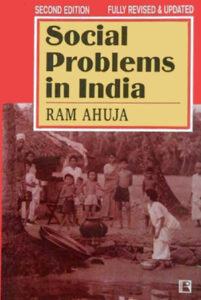
Social Problems in India is one of the leading books on the subject of sociology. The book is presented with sociological perspective being its main background.
Publisher
Rawat Publications
ISBN
8170331389
Year
1992
Pages
389
Summary
The book is most relevant for students studying sociology but is also equally material for people from all respects of life. It is useful for students who are preparing for competitive examinations and also to administrators, policy makers and planners.
All change is not necessarily progress. India has changed considerably over the last forty years and continues to change even today. But what is the direction of this change? What is its logic? Who is being benefited by it?
Violence, despite repeated declarations to curb it, continues unabated. Communalism is on the rise. Poverty and unemployment, despite the reassuring promises of successive governments—the early Congress government, the National Front government, the Janata (S) government, and once again the present Congress government—continue to increase. Atrocities against women, Harijans, and other weaker sections of society show no sign of decline.
Youth are becoming increasingly frustrated and are resorting to agitation. Politics has become criminalized. Secessionism has been curbed, but terrorism is growing more virulent and strident. Corruption has not been eliminated; it persists under different labels. Peasants, industrial workers, and government employees are in distress. Social values are rapidly deteriorating.
An increasing number of people are becoming victims of mental illness. Crime, delinquency, drug abuse, and alcoholism are on the rise. The country is thus confronted with innumerable and complex social problems.
It is time to analyze and understand the nature and magnitude of these problems. It is time that social scientists employ theoretical perspectives in their evaluation. It is also time that planners and power elites consider appropriate remedial measures to reform existing subsystems, structures, institutions, and laws in order to contain these problems. A democracy committed only to the status quo and non-planning may degenerate into a democracy of death and destruction.
This volume represents a humble attempt to examine contemporary social problems in India from a sociological perspective. Most of the chapters are based on data collected through my own empirical studies. In addition, the analysis draws upon the ideas and research of several scholars and academic professionals. It is not possible, however, to acknowledge individually every social thinker whose work has informed this study.
Contents
Chapter 1: Social Problems
The concept of social problems
Characteristics of social problems
Reactions to social problems
Causes of social problems
Theoretical approaches to social problems
Types of social problems
Methods of studying social problems
Stages in the development of a social problem
Rural and urban problems
Solving social problems
Social problems and social change in India
Sociology, sociologists, and social problems
Chapter 2: Poverty
The concept of poverty
Problems of the poor and the pains of poverty
Anti-poverty strategies
Effective measures in poverty alleviation
Chapter 3: Unemployment
Magnitude of unemployment
Types of unemployment
Causes of unemployment
Consequences of unemployment
Measures taken to control unemployment
Evaluation of measures adopted
Remedies for unemployment
Chapter 4: Population Explosion
Causes of population growth
Effects of population explosion
Measures suggested to control population growth
Chapter 5: Communalism and Communal Violence
Concept of communalism
Communalism in India
Communal violence
Causes of communal violence
Theories of communal violence
Role of the police
Prescriptive measures
Chapter 6: Backward Castes, Tribes, and Classes
Welfare measures undertaken
Scheduled tribes
Scheduled castes
Other backward castes and classes
Reservation policy
Chapter 7: Youth Unrest and Agitations
Concept of youth unrest
Characteristics of youth unrest
Youth protests, agitations, and movements
Process of growth of youth agitations
Important youth agitations in India
Types of youth agitations
Youth receptivity to agitations
Limitations of youth agitations
Causes of youth unrest and agitations
Theories on the causes of youth agitations
Youth leadership
Youth agitations and police
Controlling youth agitations
Chapter 8: Child Abuse and Child Labour
Child population and working children
Concept and types of child abuse
Incidence of child abuse
Theoretical explanations of child abuse
Victims of abuse
Causes of child abuse
Effects of abuse on children
The problem of child labour
Chapter 9: Violence Against Women
Women’s harassment
Nature, extent, and characteristics of violence against women
Violence against widows
Victims of violence
Perpetrators of violence
Motivations behind violence
Theoretical explanations of violent behaviour
Depersonalization, trauma, and humanistic approach
Chapter 10: Illiteracy
Educational development
Magnitude of illiteracy
National policy on education
Measures adopted for eradicating illiteracy
Tapping student power
Efforts by voluntary organizations
Chapter 11: Urbanization
Concepts of urban, urbanization, and urbanism
Characteristics of urbanism or urban system
Growth of urban areas
Social effects of urbanization
Problems of urbanization
Causes of urban problems
Solutions to urban problems
Chapter 12: Crime and Criminals
The concept of crime
Crime, criminal, and criminology
Salient characteristics of crime in India
Theoretical explanations of criminal behaviour
Confinement and correction of criminals
Chapter 13: Juvenile Delinquency
Classification of juvenile delinquents
Nature and incidence
Characteristics of juvenile delinquency
Types of juvenile delinquency
Factors involved
Sociology of juvenile delinquency
Methods of treating delinquents
Custody in juvenile institutions
Preventive programmes
Chapter 14: Alcoholism
The concept of alcoholism
Extent of alcoholism
Process of becoming an alcoholic
Treatment of alcoholics
Control of alcoholism
Chapter 15: Terrorism
Characteristics of terrorism
Objectives of terrorism
Origin and development of terrorism
Perspectives on terrorism
Mass support
Terrorism in India
Terrorism in other countries
Theoretical explanations of the causes of terrorism
Combating terrorism
Sociology of terrorism
Chapter 16: Drug Abuse and Drug Addiction
Basic concepts
Nature and impact of abusable drugs
Extent and nature of drug abuse
Motivations for drug use
Role of family and peer group in drug abuse
Theories of causation
Measures for combating drug trafficking, treating addicts, and preventing drug abuse
Control of drug abuse
Chapter 17: Black Money
The concept of black money
Magnitude and prevalence
Causes of the generation of black money
Social effects of black money
Measures of control
Autor
Ram Ahuja is a distinguished Indian sociologist best known for his extensive
contributions to the study of social problems, criminology, and social deviance
in India. He served as Professor of Sociology at the University of Rajasthan,
Jaipur, where he played an important role in the development of sociological
teaching and research.
His scholarly work is characterized by a strong empirical orientation, combined
with clear theoretical frameworks aimed at understanding contemporary Indian society.
Ahuja’s research focuses on issues such as crime, poverty, unemployment, corruption,
violence, social inequality, and youth delinquency, emphasizing the structural and
institutional roots of these problems rather than purely individual explanations.
Ram Ahuja is the author of several influential and widely used textbooks, including
Social Problems in India, Criminology, Indian Society, and
Crime and Deviance. These works have become standard reading in undergraduate
and postgraduate courses in sociology, criminology, social work, and related disciplines
across India and South Asia.
Through his accessible style and systematic analysis, Ram Ahuja has made a lasting
contribution to applied and policy-oriented sociology, bridging the gap between
sociological theory, empirical research, and social reform.