In attempts to define the concept of the “family business,” three prominent approaches have been discussed: the involvement approach, the essence approach, and the family firm identity approach
Publisher
Springer
ISBN
9783658422158
Year
2023
Pages
304
Summary
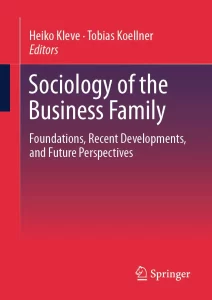
Family sociologists have conducted empirical research and developed theories on a wide range of family topics and family forms. In this context, it is surprising that one particular family form has so far received little attention in family sociology: the business family. This topic has also been largely neglected in classical economic research, where the primary focus has been on the family business rather than on the business family itself. This neglect is especially unsatisfactory given that the family business is the dominant type of enterprise shaping the economic system in Germany and in many other countries. It is precisely the business family that differentiates this type of enterprise from others.
In attempts to define the concept of the “family business,” three prominent approaches have been discussed: the involvement approach, the essence approach, and the family firm identity approach. Among these, the involvement approach has been particularly influential. It emphasizes that family businesses are enterprises founded by families or by members of one or more families and managed by them at least into the second generation.
According to this approach, family members own the company, are involved in its operations, and/or act as shareholders, thereby exercising decisive influence over the firm. Building on this understanding, the essence approach highlights the fundamental differences between family and non-family businesses. From this perspective, the ownership and active involvement of a family group give rise to a distinctive mode of operating the firm, which in turn produces a specific family firm identity—an idea further developed in the family firm identity approach.
This book is a translation of the original German edition “Soziologie der Unternehmerfamilie” by Kleve, Heiko, published by Springer Fachmedien Wiesbaden GmbH, in 2019. The translation was done with the help of arti cial intelligence (machine translation by the service DeepL.com).
A subsequent human revision was done primarily in terms of content, so that the book will read stylistically differently from a conventional translation
Contents
Foundations, Recent Developments and Future Perspectives of a Sociology of the Business Family: An Introduction – Tobias Koellner & Heiko Kleve
Preliminary Remarks
Foundations
Recent Developments
Future Perspectives
Brief Overview of the Contributions
References
The Hunger for Human Capital: Industrial Society and Family Development – Hans Bertram
The Household as a Place of Production
The Family as a Factory of the Child’s Personality
The Order of the Family
Human Capital and the Catholic Worker Girl
The Question of the Future of the Post-industrial Society
Free Time, Outsourcing of Intimacy and the Institutionalization of Childhood
Human Capital, Family Development and a New Life Course
References
Western (Business) Family Models in Historical Change: A Process–Sociological Sketch – Désirée Waterstradt
Theoretical Foundations
Household and Production Communities Through the Course of Time
Business Family: A Process–Sociological Reflection of the Term
Conclusion
References
Families and Organizations: Similarities, Differences and Linkages – Stefan Kühl
Different Concepts of Membership
The Differentiation of Groups, Organizations, Movements and Families
Entanglements, Combinations and Transitions of Families and Organizations
References
Empirical Findings on Business Families in Germany – Isabell Stamm, Fabian Bernhard & Nicole Hameister
Conceptual Considerations on Business Families
Identification of Business Families in Germany
Conceptual Considerations for the Construction of a Comparison Group
Propensity Score Matching
Final Considerations and Evaluation
References
From the Family Business to the Business Family – Rudolf Wimmer & Fritz B. Simon
The Structural Change of the Family on the Way to Modernity
The Business Family as a Family of Its Own Type
The Special Role of the “Third Party”
The Internal Differentiation of Business Families
Wordless Understanding: A Necessary Fiction?
References
Social Plurality and Family Identity: Succession in Family Businesses – Gabriela Leiß
Business Families in Transition
Succession in Business Families: A Theoretical Framework
Succession Negotiation in Business Families
Business Families in Reflexive Modernity
References
The Business Family as a Family of Its Own Kind in the Process of Social Change – Daniela Jäkel-Wurzer
The Concept of Family in a Changing Society
The Family as a System of Social Interaction
The Female Role and Its Development
Succession in the Context of Current Social Developments
Opportunities and Challenges of the Change Process
Conclusion and Outlook
References
Socialization and Parenting Processes in Business Families – Elke Schröder
Socialization Requirements in Business Families
Transmission of Values Between Parents and Children
Career Orientation and Succession Planning
Conclusion and Outlook
References
The Dynastic Extended Family – Tom A. Rüsen, Arist von Schlippe & Heiko Kleve
Dynastic Extended Families
Specific Challenges in Dynastic Extended Families
Communication within the Circle of Shareholders
Conclusion
References
The “Tripled” Family: Dynastic Business Families – Heiko Kleve, Arist von Schlippe & Tom A. Rüsen
Families
Formally Organized Business Families
Large Business Families as Networks
Networking in Large Business Families
Conclusion
References
Company, Family, Business Family – Arist von Schlippe & Torsten Groth
The Business Family as a Social System
The “Duplicated” Family
Polycontexturality
References
The Doing Family Concept – Tobias Koellner & Heiko Kleve
Social Change and Modernization Processes
Doing Family: The Creation of Cohesion
Doing Family in the Business Family 1.0
Doing Family in the Business Family 2.0
Doing Family in the Business Family 3.0
Conclusion and Practical Relevance
References
Autor
Heiko Kleve Prof. Dr., is sociologist and social pedagogue, holder of the Chair for Organization and Development of Business Families at WIFU – Witten Institute for Family Business, Faculty of Economics, University of Witten/Herdecke.
Tobias Koellner Dr. Habil., is anthropologist and sociologist, Senior Reserch Fellow at the WIFU – Witten Institute for Family Business. Faculty of Economics, University of Witten/Herdecke.
Book Details
Title
Sociology of the Business Family
Subtitle
Foundations Recent Developments, and Future Perspectives