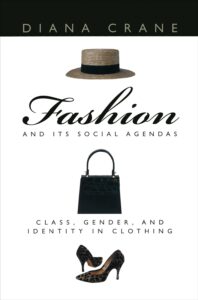
In Fashion and its Social Agendas, the author examine fashion and clothing choices in nineteenth-century industrial and contemporary postindustrial societies, drawing examples from France, the United States, and England.
Publisher
The University of Chicago Press
ISBN
9780226924830
Year
2000
Pages
436
Summary
In class societies, each class had a distinct culture which differentiated it from other classes, but at the same time it shared certain values, goals, and gender ideals with other classes. In contemporary, “fragmented” societies, class distinctions are important in the workplace, but, outside the workplace, distinctions are based on criteria that are meaningful to the numerous and diverse social groups in which they originate but not necessarily to members of other social groups.
How do fashion and clothing choices differ in societies where social class and gender are the most salient aspects of social identity, as compared with societies where lifestyles, age cohorts, gender, sexual orientation, and ethnicity are as meaningful to people as social class in constructing their self-images and in their presentation of self? Changes in the dissemination of fashion and in clothing choices can be used to trace and interpret these transformations in class cultures.
The best-known theory of fashion and clothing behavior is Simmel’s theory of fashion change as a process of imitation of social elites by their social inferiors (1957). Writing at the beginning of the twentieth century, Simmel delineated the role of fashion as it had developed in nineteenth-century societies, in which social classes had relatively distinct class cultures. Simmel’s model of fashion change was centered on the idea that fashions were first adopted by the upper class and, later, by the middle and lower classes. Lower-status groups sought to acquire status by adopting the clothing of higher-status groups and set in motion a process of social contagion whereby styles were adopted by groups at successively inferior status levels.
By the time a particular fashion reached the working class, the upper class had adopted newer styles, since the previous style had lost its appeal in the process of popularization. The highest-status groups sought once again to differentiate themselves from their inferiors by adopting new fashions.
Contents
Working-Class Clothing and the Experience of Social Class in the Nineteenth Century
Fashion, Democratization, and Social Control
Women’s Clothing Behavior as Nonverbal Resistance: Symbolic Boundaries, Alternative Dress, and Public Space
Fashion Worlds and Global Markets: From “Class” to “Consumer” Fashion
Men’s Clothing and the Construction of Masculine Identities: Class, Lifestyle, and Popular Culture
Fashion Images and the Struggle for Women’s Identity
Fashion and Clothing Choices in Two Centuries
Extract
Clothing, as one of the most visible forms of consumption, performs a major role in the social construction of identity. Clothing choices provide an excellent field for studying how people interpret a specific form of culture for their own purposes, one that includes strong norms about appropriate appearances at a particular point in time (otherwise known as fashion) as well as an extraordinarily rich variety of alternatives. One of the most visible markers of social status and gender, and therefore useful in maintaining or subverting symbolic boundaries, clothing is an indication of how people in different eras have perceived their positions in social structures and negotiated status boundaries. In previous centuries, clothing was the principal means for identifying oneself in public space.
Depending on the period, various aspects of identity were expressed in clothing in Europe and the United States, including occupation, regional identity, religion, and social class. Certain items of clothing worn by everyone, such as hats, were particularly important, sending instant signals of ascribed or aspired social status. Variations in clothing choices are subtle indicators of how different types of societies and different positions within societies are actually experienced.
Author
Diana Crane is an American sociologist recognized for her contributions to the study of culture, knowledge, and fashion. She is best known for her book Invisible Colleges, in which she examines how informal networks of scholars shape the development and diffusion of scientific ideas. Crane later expanded her focus to fashion, analyzing how clothing reflects social structures, identity, and cultural change.
In Fashion and Its Social Agendas, she challenged traditional elite-driven models of fashion by emphasizing the influence of media, globalization, and diverse social groups. Her work highlights how everyday practices like dress connect to broader systems of meaning, power, and social interaction.