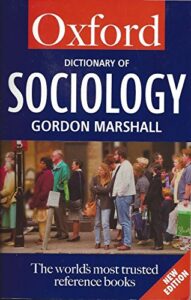
Oxford Dictionary of Sociology is the most comprehensive, authoritative, and up-to-date dictionary of sociology available in a single volume. Compiled by an expert team of sociologists under the editorship of Gordon Marshall, the text has been fully revised and updated for this new edition.
Publisher
Oxford University Press
ISBN
0192800817
Year
1998
Pages
712
Summary
Oxford Dictionary of Sociology is an entirely new compilation written by a distinguished team of sociologists from one of the leading sociology departments in Europe. It is intended primarily for readers who are relatively new to the discipline.
To make the dictionary easier to use, abbreviations have been avoided throughout the text. An asterisk (*) placed before a word in a definition indicates that additional relevant information can be found under a separate entry. Some entries simply refer the reader to another term, either because they are synonyms or because they are best explained together with related concepts in one of the dictionary’s longer articles.
As a general rule, nouns with a qualifying adjective can be searched for under either word. For example, “nuclear family” is also listed under “family, nuclear.” All major entries, and many shorter ones, include at least one bibliographical reference to allow readers to pursue the relevant literature independently. These references are intended to be useful to both American and British students, despite differences in the historical development of the discipline in these countries, although some entries do point readers in slightly different directions on either side of the Atlantic.
Sociology itself has a clear theoretical core but an inevitably diffuse perimeter. This can be seen as one of the discipline’s main strengths, since it enables the study of genuinely interdisciplinary problems, including many of today’s major social issues. As a result, sociologists frequently encounter terminology from related fields such as economics, psychology, and anthropology. For this reason, the dictionary includes a number of entries that belong primarily to these cognate disciplines but are also relevant and useful to students of sociology.
In recent years, sociology dictionaries have increasingly included brief biographical entries on contemporary practitioners. These entries often amount to little more than dates of birth, institutional affiliations, and short publication lists. The rationale for this practice is unclear, since such dictionaries are intended to clarify the concepts and terminology of the discipline rather than to provide annotated lists of its proponents.
Moreover, preliminary research for this dictionary showed that it was impossible to reach a consensus on who should be regarded as the “leading contemporary sociologists,” partly due to the diversity of the field itself. For this reason, this dictionary includes personal names only where individuals have themselves become sociological subjects, usually because of their influence on the subsequent history of the discipline.
A further criterion is the exclusion of living scholars. As a result, entries are included for figures such as Max Weber and Erving Goffman, but not for Robert K. Merton or John H. Goldthorpe. This decision arguably excludes some contemporary sociologists whose work has already become an object of study within the discipline, such as Anthony Giddens, Jürgen Habermas, and Pierre Bourdieu. Some readers may think this makes only biological but not intellectual sense. In practice, however, the inclusion of any living sociologists as subjects merely reintroduces irresolvable disputes about who, among the current generation, are sufficiently influential—or controversial—to constitute proper ‘topics’ for inclusion.
Naturally, the work of all these writers is here discussed in the context of wider substantive entries, as for example under the headings of critical theory (Habermas), anomie (Merton), and social mobility (Goldthorpe). All the contributors to the dictionary were, at the time of its inception, on the staff of the Department of Sociology at the University of Essex, Colchester, UK. The fact that many have since moved on is entirely coincidental.
Contents
For this edition, I have revised and expanded much of the original text. More than 150 new entries—including several substantial essays—have been added, making the volume approximately 45,000 words longer than its predecessor. I have also corrected a number of minor errors that were brought to my attention by readers of the dictionary.
I would like to take this opportunity to thank the many readers who wrote either to me or to Oxford University Press, often offering helpful suggestions for improvement and, at times, simply expressing their appreciation of the finished work. One correspondent from India suggested the inclusion of a consolidated bibliography. However, I remain unconvinced that this would be more useful to students than the current practice of providing references within individual entries. For this reason, the format of the earlier edition has been retained.
After further reading on the subject, I also find myself unable to agree with the late Professor Hans Eysenck, who kindly sent a thoughtful letter explaining why he believed that one of the entries presented an unbalanced view of the evidence concerning genetic differences in human behaviour. That said, the discussion of intelligence has been expanded to include some of the more recent—and still controversial—literature on the topic.
Once again, I have been the principal contributor to this edition. However, several friends and former colleagues from the Department of Sociology at the University of Essex generously contributed specialist entries, including Tony Coxon, Ian Craib, Diana Gittins, Catherine Hakim, Maggy Lee, Sean Nixon, and Nigel South. Their contributions and advice have greatly enhanced the dictionary. Any remaining shortcomings are entirely my own responsibility.
Author
Gordon Marshall is an Official Fellow of Nuffield College, Oxford. His published works include Presbyteries and Profits (1980), In Search of the Spirit of Capitalism (1982), In Praise of Sociology (1990), Repositioning Class (1997), and, with other authors, Social Class in Modern Britain (1988).
He is also a co-author of Against the Odds?, a cross-national comparative study of social class and social justice in industrial societies, published by Oxford University Press in 1997.
The dictionary was commissioned while he was a Senior Lecturer at the University of Essex, and all entries were written by contributors who were members of the Essex sociology department at that time.