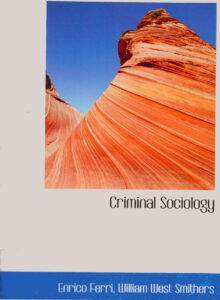
Criminal Sociology by Enrico Ferri is a pioneering work that explains crime as the result of biological, psychological, and social factors, arguing for prevention, social reform, and individualized justice rather than punishment alone.
Publisher
BiblioLife
ISBN
1173214658
Year
1917
Pages
577
Summary
Enrico Ferri’s Criminal Sociology is a foundational work in the development of modern criminology and a central text of the Italian Positive School of criminal law. Originally published at the end of the nineteenth century, the book represents a decisive break from classical theories of crime that focused on free will and moral responsibility. Instead, Ferri proposes a scientific and sociological approach that understands crime as the product of biological, psychological, and social forces.
Scientific Approach to Crime
At the core of Ferri’s argument is the rejection of the classical notion that crime is solely the result of individual choice. Drawing on data from anthropology, psychology, and criminal statistics, he argues that human behavior is shaped by determinable causes and that criminal conduct must be studied empirically. This shift allows criminology to move away from abstract legal philosophy and toward an evidence-based science of social behavior.
Classification of Criminal Types
One of the book’s most influential contributions is Ferri’s classification of criminals into distinct types, such as the born criminal, the insane criminal, the habitual criminal, the occasional criminal, and the criminal by passion. This typology emphasizes that offenders are not a homogeneous group and that penal responses should be adapted to different forms of criminality rather than imposed uniformly.
The Law of Criminal Saturation
Ferri introduces the concept of the “law of criminal saturation,” which suggests that every society produces a relatively stable amount of crime according to its social, economic, and cultural conditions. From this perspective, harsher punishments alone cannot significantly reduce crime. Instead, Ferri advocates for preventive social reforms—improvements in education, labor conditions, housing, public health, and family life—as more effective means of reducing criminal behavior.
Penal Responsibility and Social Defense
Another key aspect of Criminal Sociology is Ferri’s theory of penal responsibility without free will. While denying free will in a metaphysical sense, he does not deny social responsibility. Punishment, for Ferri, should be replaced or supplemented by social defense measures aimed at protecting society and rehabilitating or neutralizing dangerous individuals. This includes indeterminate sentences, treatment-oriented institutions, and individualized sanctions.
Historical Importance and Limitations
Although some of Ferri’s biological assumptions reflect the scientific context of his time and are now considered outdated, the broader sociological framework he developed remains highly influential. His emphasis on empirical research, social causes of crime, and prevention anticipated many modern criminological theories.
Conclusion
Overall, Criminal Sociology stands as a landmark work that transformed the study of crime from a purely legal doctrine into an interdisciplinary social science. It remains essential reading for students and scholars interested in the historical foundations of criminology and in the enduring debate between punishment and prevention.
Contents
PRELIMINARY SECTIONS
General Introduction to the Modern Criminal Science Series
Editorial Preface by William W. Smithers
Introduction by Charles A. Ellwood
Introduction by Quincy A. Myers
Author’s Preface to the American Edition
List of Abbreviations
INTRODUCTION: THE POSITIVE SCHOOL OF CRIMINAL LAW
I. The classical criminal school inaugurated by Beccaria. The classical penitentiary school inaugurated by Howard. Application of the positive method to criminal law.
II. First accusations against the positive school. The eclectics. Scientific and practical expansion.
Criminal Sociology
Origin of Criminal Sociology
The Classical Criminal School inaugurated by Beccaria
The Classical Penitentiary School inaugurated by Howard
Beccaria and Howard and their Limitations
The Positive Method
The Positive Method and the Social Sciences
The Application of the Positive Method to Criminal Law
The Failure of Classical Criminology
The Positive Method in Political Economy
Programme of the New School
Eclecticism
The "Third School"
The Positive Criminal School is in its Third Period
The International Congresses of Criminal Anthropology
The International Union of Criminal Law
Practical Applications of the Positive School
Criminal Sociology — The Programme
PART I: DATA OF CRIMINAL ANTHROPOLOGY
Chapter I: Natural History of Criminal Man
The Genesis of the Anthropological Criminal School
The Methods of the Anthropological Criminal School
Value of Anthropological Data in Anthropology and Criminal Sociology
Craniological Data
Physical Data
Criminal Psychology; Moral Insensibility and Lack of Foresight
Chapter II: Fundamental Objections to the Data of Anthropology
Objections Advanced against Criminal Anthropology
Methods Employed in the Study of Criminals; Small Number Examined
Inexactness of Comparisons
Scientific Assumptions of Criminal Anthropology
Influence of Organic Conditions upon Moral Conduct
Sources of Objections to Anthropological Data
Qualitative and Quantitative Disagreements in the Data
Disagreements in the Data More Apparent than Real
Miscitation as the Basis of Criticism
The Presence of Criminal Traits in the Honest and in the Non-criminal Insane
Accumulation of Criminal Traits Necessary to Mark the Criminal
Counterbalancing of Criminal by Other Traits
Variable Predominances of Parents in Offspring
Criminal Traits so called do not necessarily Result in Crime
Influence of Circumstances in Restraining the Criminal
Possibility of Crime Existent in a Man of Criminal Traits at All Ages
Apparent Honesty in Face of Anthropological Data
Historical and Anthropological Indetermination of Crime
Indetermination of Crime not All-inclusive
Connotation of Crime Changes; not so Criminality
The Social Environment gives the Form to Crime based on Biological Factors
Juridical Crime and the Criminal from a Sociological Point of View
The Proper Subject of Criminal Anthropology
Sociological Definition of Crime
Criticism: Harmless Acts held Criminal
Criticism: Punishability of Penalty
Eclectic Definition of Crime
Durkheim’s Definition of Crime
Biological Definition of Crime
Sociological and Biological Bases of Crime
Distinction between Anti-human and Anti-social Criminality
The Existence of an Anthropological Criminal Type
Physiognomy most important in Determining a Criminal
Objections to the Determination of a Criminal Type
Objection: Development of the Thief into the Murderer
Objection: The Anthropological is a Professional Type
Anthropological Criminal Class — A Restatement
Heredity and Environment
Criminal Etiology
Hypotheses as to Nature and Origin of Crime
Biological Norm or Basis of Origin
Sociological Norm as Basis of Origin
Biological Abnormality: Organic or Psychic Atavism
Biological Abnormality: Epilepsy
Organic or Psychic Atavism
Neurosis or Neurasthenia
Degeneracy
Defective Nutrition
Defective Development of Inhibitive Centers
Moral Anomaly
Biological Abnormalities Summary
Complex Basis of Origin and Nature of Crime
Social Abnormality: Economics
Social Abnormality: Juridical Inadaptation
Social Abnormality: Complex Social Influences
Biologico-social Abnormality
Crime is a Phenomenon of Biologico-Social Abnormality
Chapter III: Natural Classification of Criminals
History of the Distinction of Criminal Categories prior to Lombroso
Conclusions from History of Distinctions of Criminal Categories prior to Lombroso
Applicability of Anthropological Data restricted to Certain Categories
Statistics of Criminal Relapse
Criminal Relapse the Rule
Proportion of Recidivity in Crimes against the Person
Proportion of Recidivity in Crimes against Property
Statistics of Relapse Reinforce Conclusions
Larger Percentage of Habitual Delinquency
Percentage in Habitual Delinquency between "Others" and "Total"
Five Categories of Criminals: Insane, Born, Habitual, Occasional, and by Passion
The Criminal Insane
The Mattoide and Semi-insane Categories
The Born-criminal Category
The Habitual Delinquent Category
Precocity and Recidivity; Traits of the Habitual Criminal
Two Objections to Precocity as a Mark of the Categories of Born and Habitual Criminals
Objection to Recidivity as a Mark of the Categories of Born and Habitual Criminals
The Criminal through Passion Category
The Occasional Criminal Category
Difference between Categories One of Degree
Application of Class Division of Criminals
Numerical Proportions of the Five Categories of Criminals
Other Classifications of Criminals
Colajanni and Lombroso Accept the Five Classes of Delinquents
New Basis for Legal Science
Five Classes a Natural Division
PART II: DATA OF CRIMINAL STATISTICS
Chapter I: Methods of Collecting Criminal Statistics
Importance of Criminal Statistics
Method of Collecting and Studying Criminal Statistics
Use and Abuse of Statistics
Ethico-social Inductions from Criminal Statistics
Criminal Sociological Demands of Statistics
Biological Aspect of Criminal Statistics
Statistics and History
Distinction between Natural and Legal Crime
Chapter II: Civilization and Crime
Evolution of Crime; Pathological Incidents of Civilization
Evolution of Crime in Civilization
Evolution of Crime
Crime and Education
Crime and Ease of Conditions of Life
Numerical Increase in Crime shown by Statistics
Actual Increase in Crime
Anthropological Factors in Crime; Organic Constitution of the Criminals
Anthropological Factors in Crime; Psychical Constitution of the Criminals
Anthropological Factors in Crime; Personal Characteristics of the Criminals
Physical Factors in Crime
Social Factors in Crime
Classifications of the Factors in Crime
Ratio of Civil and Penal Justice
Criticism of Colajanni’s Classification of Crime
Criticism of Aramburn’s Classification of Crime
Criticism of Tarde’s Classification
Complexity of Origin of Crime
Ratio of Productivity of Different Factors in Crime
Chapter IV: Law of Criminal Saturation
Law of Criminal Saturation
Annual Criminal Variations
Reflex and Complementary Crime
Prevention of Crime, not Punishment needed
Chapter V: Equivalents for Punishment (Penal Substitutes)
Need of Other Means of Social Protection than Punishment
Penal Substitutes
Economic Order: Freedom of Emigration, Taxation, Public Works
Relation of Alcohol to Crime
Physical and Psycho-pathogenic Influence of Alcohol
Alcoholism and Drunkenness
PART III: POSITIVE THEORY OF PENAL RESPONSIBILITY
Chapter I: The Negation of the Free Will
Problem of Penal Responsibility
Basis of the Right of Punishment
Moral Liberty
Process of Action
Moral Liberty an Impossibility
Indivisibility of the Human Mind
No Free Will Because Willing not an Entity
Statistics Prove that There is No Free Will
No Limited Freedom of Will
Free Will is Denied by Science
Equivocal Meanings of Moral Liberty
Denial of Free Will is not Fatalistic
Theory of Limited Moral Freedom in Practical Jurisprudence
Chapter II: The Problem of Penal Justice with the Denial of Free Will
Penal Law Denying Moral Liberty
Basis of Responsibility
Need of History to determine Basis of Responsibility
Evolution of Defensive Reaction
Identity of Military and Legal Reaction
Penal Function Defensive and Unconnected with Conditions of Moral Liberty
PART IV: PRACTICAL REFORMS
Chapter II: Principles for Procedural Reform
Three Great Principles of the Positive School or Procedural Reform
Equality between Individual Rights and Social Defense
Reparation to a man unjustly convicted
Abolition of Certain Crimes
Chapter IV: The Jury
Positivistic Abolition of the Jury System
Arguments in Favor of the Jury System
The Jury System: its Advantages and Disadvantages
The Jury as a Juridical Institution
The Capital Fault of the Jury System
The Insufficiency of the Jury: Personal Capacity
The Insufficiency of the Jury: The Incoherence of its Acts
The Jury Considered Psychologically and Sociologically
Chapter V: Bankruptcy of the Classical Penal System
The Bankruptcy of the Classical Penal Systems
Fundamental Criteria of the System of Social Defense
Segregation for an Indeterminate Period
Reparation in Damages
Prisons must be Hospitals where Delinquency is Treated
Chapter VII: Conclusion
The Future of Penal Science and Practice
Relations between Penal Law and Criminal Sociology
Value of Origin of Crime as a Basis of Criminology
Ultimate Significance of New Discoveries and Methods
The Penal Science of the Future
Extract
In the opinion of the writer, Ferri should be called the first of living criminal sociologists. The translation of this, his greatest work, into English is a service for which all students of criminology and sociology should be grateful to the American Institute of Criminal Law and Criminology.
Criminal Sociology may be regarded as a special application of general sociology to the problem of crime and to the treatment of the criminal. Sociology, on the other hand, is a general or synthetic science of the whole life of human society—its origin, development, organization, and functioning.
Criminal Sociology, therefore, comes near to being the whole of criminology, both in its theoretical and in its practical aspects, insofar as the latter aims to furnish a synthetic view of the problem of crime and of the treatment of the criminal as a whole. It is in this sense that our author, Professor Ferri, evidently understands the term “Criminal Sociology” as the title of the present work.
We have a right to ask first of all, therefore, what the social philosophy is upon which Professor Ferri bases his Criminal Sociology. The work before us is not a mere empirical study of the causes and conditions of crime in the social environment. It is rather a Criminal Sociology in the sense in which we have just defined that term.
To discover Professor Ferri’s social philosophy, however, we must turn to his other works, as well as to his Criminal Sociology. His New Horizons of Criminal Law and Penal Procedure, his Socialism and Criminality, his Socialism and Modern Science, and his three lectures on The Positive School of Criminology furnish material which gives us a fairly clear insight into his general sociology.
We shall, accordingly, make use of the above works in attempting a critical estimate of Professor Ferri’s Criminal Sociology.
Author
Enrico Ferri (1856–1929) was an Italian criminologist, jurist, and socialist politician, widely recognized as one of the founders of the positivist school of criminology. Alongside Cesare Lombroso and Raffaele Garofalo, Ferri helped transform the study of crime from a purely legal and moral issue into a scientific field grounded in sociology, psychology, and biology.
Early Life and Education
Born in San Benedetto Po, Italy, Ferri studied law at the University of Bologna, where he became deeply influenced by emerging scientific approaches to human behavior. Early in his career, he rejected classical theories that viewed crime mainly as a product of free will, instead emphasizing that criminal behavior is shaped by a complex interaction of individual, social, and environmental factors.
Major Works and Theoretical Contributions
Ferri’s most influential work, Criminal Sociology, presented a comprehensive theory of crime that integrated biological predispositions, psychological traits, and social conditions such as poverty, inequality, and lack of education. He argued that effective crime control should focus on prevention, rehabilitation, and social reform rather than solely on punishment.
He also developed the concept of social defense, which proposes that society must protect itself through policies that reduce the causes of crime while respecting human dignity.
Political Activity
Beyond academia, Ferri was an active political figure and served for many years as a member of the Italian Parliament. He believed that criminology should contribute directly to social justice and public policy, advocating for labor rights, improved education, and humane treatment of offenders.
Legacy
Enrico Ferri’s legacy endures in modern criminology through his emphasis on empirical research, interdisciplinary analysis, and the idea that crime must be understood within its broader social context. His work helped lay the foundations for contemporary theories of social defense, penology, and criminal psychology.