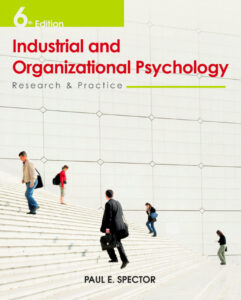
Industrial and Organizational Psychology Paul E. Spector
Overview
Industrial and Organizational Psychology: Research and Practice by Paul E. Spector examines how psychological research improves work behavior, performance, well-being, motivation, and organizational effectiveness.
Publisher
Wiley
ISBN
9780470949764
Year
2012
Pages
455
Summary
Industrial and Organizational Psychology: Research and Practice by Paul E. Spector is a foundational and widely used textbook that explores how psychological principles and scientific research are applied to the world of work. The book examines the relationship between individuals and organizations, focusing on how work environments influence behavior, attitudes, performance, and well-being. Spector integrates theory, empirical research, and practical applications, making the book valuable for both students and practitioners of industrial and organizational psychology.
The text covers key topics such as job analysis, employee recruitment and selection, training and development, performance appraisal, motivation, leadership, and organizational decision-making. It also gives significant attention to job satisfaction, organizational commitment, counterproductive work behavior, and the psychological factors that shape employee effectiveness.
A central theme of the book is the importance of evidence-based practice, emphasizing rigorous research methods, measurement, and statistical analysis as essential tools for improving organizational outcomes.
In addition, Spector addresses critical issues related to occupational stress, work–life balance, health, and safety, highlighting the impact of work on both mental and physical health. By linking research findings to real organizational challenges, the book demonstrates how industrial and organizational psychology contributes to the creation of productive, ethical, and healthy workplaces.
Contents
Part I. Introduction
Chapter 1. Introduction
What Is I/O Psychology?
Activities and Settings of I/O Psychologists
I/O Psychology as a Profession
I/O Psychology as a Science
History of the Field of I/O Psychology
I/O Psychology Beyond the United States and United Kingdom
What It Takes to Become an I/O Psychologist
Internet Resources for I/O Psychologists and Students
Ethics of the I/O Field
Humanitarian Work Psychology
Chapter Summary
Chapter 2. Research Methods in I/O Psychology
Research Questions
Important Research Design Concepts
Variables
Research Setting
Generalizability
Control
Random Assignment and Random Selection
Confounding
Research Designs
Experiments
Survey Designs
Observational Designs
Qualitative Studies
Measurement
Classical Measurement Theory
Reliability
Validity
Statistics
Descriptive Statistics
Measures of Central Tendency and Dispersion
Correlation
Regression
Inferential Statistics
Meta-Analysis
Mediator and Moderator Variables
Ethics of Research
Chapter Summary
Part II. Assessment of Jobs, Performance, and People
Chapter 3. Job Analysis
What Is Job Analysis?
The Job-Oriented Approach
The Person-Oriented Approach
Purposes of Job Analysis
How Job Analysis Information Is Collected
Methods of Job Analysis
Reliability and Validity of Job Analysis Information
Job Evaluation
Comparable Worth
Chapter Summary
Chapter 4. Performance Appraisal
Why Do We Appraise Employees?
Performance Criteria
Methods for Assessing Job Performance
Rater Bias and Error
360-Degree Feedback
The Impact of Technology on Performance Appraisal
Legal Issues in Performance Appraisal
Chapter Summary
Chapter 5. Assessment Methods for Selection and Placement
Psychological Tests
Ability, Personality, and Integrity Tests
Interviews
Work Samples and Assessment Centers
Electronic Assessment
Chapter Summary
Part III. Selecting and Training Employees
Chapter 6. Selecting Employees
Human Resource Planning
Recruitment
Validation Studies
Utility of Scientific Selection
Legal Issues in Selection
Chapter Summary
Chapter 7. Training
Needs Assessment
Training Design
Training Methods
Evaluation of Training Programs
Chapter Summary
Part IV. The Individual and the Organization
Chapter 8. Theories of Employee Motivation
Need Theories
Expectancy Theory
Justice and Goal-Setting Theories
Chapter Summary
Chapter 9. Feelings About Work
Job Satisfaction
Job Attitudes
Emotions at Work
Organizational Commitment
Chapter Summary
Chapter 10. Productive and Counterproductive Employee Behavior
Task Performance
Organizational Citizenship Behavior
Counterproductive Work Behavior
Chapter Summary
Chapter 11. Occupational Health Psychology
Workplace Safety
Occupational Stress
Burnout
Chapter Summary
Part V. The Social Context of Work
Chapter 12. Work Groups and Work Teams
Group Processes
Team Performance
Team Interventions
Chapter Summary
Chapter 13. Leadership and Power in Organizations
Leadership Theories
Power and Influence
Gender and Cross-Cultural Leadership
Chapter Summary
Chapter 14. Organizational Development and Theory
Organizational Development
Organizational Change
Organizational Theories
Chapter Summary
Appendix
Guide to Graduate School Admission
Extract
Psychology is the science of human (and nonhuman) behavior, cognition, emotion, and motivation. It can be subdivided into many specializations, some primarily concerned with psychological science itself (experimental psychology), and others focused on both scientific knowledge and its application to real-world problems outside research settings.
Industrial and Organizational (I/O) psychology, along with clinical psychology, belongs to this latter category, as it is concerned with both psychological science and the application of that science in practical contexts.
As its two-part name suggests, I/O psychology consists of two major divisions: the industrial (or personnel) and the organizational. Although these divisions overlap and cannot be easily separated, each emerged from different historical traditions. Industrial psychology, the older branch, adopts a management-oriented perspective focused on organizational efficiency through the effective use of human resources. It addresses issues such as job design, employee selection, training, and performance appraisal.
Organizational psychology developed from the human relations movement and focuses on understanding behavior and enhancing employee well-being in the workplace. Key topics include employee attitudes, behavior, job stress, and supervisory practices. Many core subjects, such as motivation, span both industrial and organizational concerns, linking performance and efficiency with employee satisfaction and well-being.
The largest applied subfield of psychology is clinical psychology, which focuses on the study and treatment of psychological disorders. I/O psychology is a smaller but rapidly growing field dedicated to applying scientific principles to the workplace. Unlike clinical psychologists, I/O psychologists do not treat personal or emotional disorders, though they may recommend clinical specialists for issues such as employee alcoholism or post-traumatic stress disorder (PTSD).
Author
Paul E. Spector is an American psychologist and a leading scholar in the field of Industrial and Organizational (I/O) Psychology. He is a Professor Emeritus of Psychology at the University of South Florida, where he conducted influential research on job satisfaction, work stress, and organizational behavior.
Spector is widely known for his work on employee attitudes and occupational stress, particularly for developing the Job Satisfaction Survey (JSS), one of the most frequently used instruments in organizational research. His scholarship has significantly contributed to understanding how workplace conditions affect employee well-being and performance.
Among his most notable publications is the textbook Industrial and Organizational Psychology: Research and Practice, which is internationally used in undergraduate and graduate programs. Through his research, teaching, and publications, Paul E. Spector has played a key role in shaping modern I/O psychology.