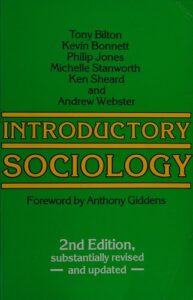
Introductory Sociology has established itself as one of the most popular textbooks in its field. The second edition is completely revised, updated and redesigned, to include additional diagrams, charts, information boxes and illustrations.
Publisher
MacMillan Press
ISBN
0333445171
Year
1987
Pages
622
Summary
Sociology is a subject that has undergone some major transformations over the past decade or so. Both on the level of social theory and in terms of the expansion of empirical research, sociology has developed along many fronts.
The task of incorporating the main elements of these developments within an introductory textbook is a formidable one. But it is a task that the authors of Introductory Sociology have accomplished in a very impressive fashion.
Introductory Sociology, in my opinion, is simply the best and most comprehensive introductory text currently available. Its virtues are several. All of the chapters are written in a clear and cogent style, but manage to initiate the reader into debates of a complex character.
The authors are particularly concerned to emphasise that sociology is an inherently controversial subject, and try to summarise several different competing views on the major topics that are analysed.
The book includes reference to the latest empirical studies, and at the same time has lengthy sections dealing with problems which have rarely figured in introductory texts previously (e.g. sexual divisions in society).
Not least important, the authors show themselves to be sensitised to contemporary trends in social theory. The “Sociological Theories” chapter presents an exemplary discussion, accessible to the beginning reader, of basic theoretical issues that anyone studying sociology today must confront.
Like several of the other chapters in the book, it is an independent contribution in its own right.
The first edition of this book deservedly became one of the standard introductions to sociology in schools, colleges and universities, and this new edition can only add to its already substantial reputation.
Anthony Giddens
Contents
Sociology: Themes and Issues
Patterns of Inequality
The Dynamics of Class
Forms of Subordination: Youth, the Poor, Race and the Third World
Gender Divisions in Society
Power and Politics
The Family
Education
Work
Belief-Systems
Deviance
The Production of Sociological Knowledge: Theory and Methods of Research
Sociological Theories
Extract
All academic disciplines or areas of study are faced with the initial problem of providing the layperson or newcomer to the discipline with some idea as to what their subject "is all about."
Most people feel that they have some understanding of the focus of disciplines like History or Physics, but are less familiar with Sociology. For sociologists, the question "What is Sociology?" frequently poses an awkward and embarrassing problem; indeed, they may feel tempted to reply "History," "English," or "Economics" when asked what they teach or study in order to simplify conversations with strangers.
Offering a single-sentence, shorthand definition such as Sociology is the study of human society and human social behaviour may seem rather vague and uninformative (though being essentially accurate), or not sufficiently precise to distinguish sociology from other disciplines such as psychology.
Sociologists may attempt to improve on this by detailing specific areas of behaviour in which they are interested: how people behave in families, why some people are involved in crime, why some children perform better at school, and so on.
Such brief thumbnail sketches do give some indication of the essence of sociology, but ultimately it is both necessary and, perhaps, more fruitful to emphasise that the most important and distinctive feature of sociology is not so much what is studied but how it is studied.
In other words, it is important to indicate the particular perspective of sociology—its distinct way of looking at the individual and society.
Author
Tony Bilton is a Principal Lecturer in Sociology at
Anglia Polytechnic University, Cambridge.
Kevin Bonnett is Director of Studies for Humanities and Arts at
Anglia Polytechnic University, Cambridge.
Pip Jones is a Senior Lecturer in Sociology at
Anglia Polytechnic University, Cambridge.
David Skinner is a Lecturer in Sociology at
Anglia Polytechnic University, Cambridge.
Michelle Stanworth is Professor of Sociology and Women's Studies at
Anglia Polytechnic University, Cambridge.
Andrew Webster is a Reader in Sociology at
Anglia Polytechnic University, Cambridge.
Book Details
Title
Introductory Sociology
Author
Tony Bilton, Kevin Bonnett, Philip Jones, Ken Sheard, Michelle Stanworth and Andrew Webster.