Sci-Net is a peer-to-peer platform for requesting academic papers and books through a crypto rewards system. It was launched in April 2025 by Alexandra Elbakyan, the creator of Sci-Hub, as a direct response to the limitations that have made Sci-Hub unable to deliver recently published research.
To understand Sci-Net, you first need to understand what happened to Sci-Hub.
For over a decade, Sci-Hub operated by automating access to scientific journals using login credentials donated by sympathetic academics around the world. The system was elegant in its simplicity: a username and password were enough to unlock millions of articles hidden behind paywalls.
That changed in 2022, when major publishers — including Elsevier, Wiley, and the American Chemical Society — implemented two-factor authentication (2FA) across their platforms. With 2FA, logging in requires confirming a link sent to the account’s registered email, something that cannot be automated. This single security update effectively cut Sci-Hub off from any paper published after 2022.
To be clear: Sci-Hub still works. It continues to handle nearly one million download requests per day and holds a database of over 88 million documents (100 terabytes). But if you’re looking for anything published in the last few years, you’ll hit a wall. That’s the gap Sci-Net was built to fill.
How the Model Evolved
Sci-Hub has always depended on community support to survive — financially and operationally. In its early days, donations came in via SMS, though high carrier fees made that unsustainable. Later, Yandex.Money (now YooMoney) became the main payment channel, followed by PayPal, which gave the project a brief window of global reach.
That window closed in 2013 when PayPal froze Sci-Hub’s account due to legal pressure from copyright holders. Services like Cloudflare and Twitter/X have also pulled the plug at various points.
Crypto as a Lifeline
Cryptocurrency has consistently been the one channel that stayed open. Bitcoin donations provided a modest but reliable income stream from the beginning. When Bitcoin’s value surged in 2017, those early donations turned into meaningful capital that kept Sci-Hub running for years.
Alexandra Elbakyan had previously attempted to create an official Sci-Hub token to fund projects aligned with the DeSci movement — Decentralized Science — which uses blockchain and Web3 technologies to support open science initiatives. That first attempt didn’t succeed. But the idea didn’t go away.
The Rewards Model
The crypto rewards model isn’t new. One well-known example is Brave browser’s Rewards program, which pays users in Basic Attention Token (BAT) for viewing non-intrusive ads. The principle is the same: active participation earns real value.
After considerable groundwork, the official $Sci-Hub (SCI) token launched in June 2025, with a total supply of 888,888 tokens running on the Solana network. With that in place, Sci-Net became possible.
What Is Sci-Net?
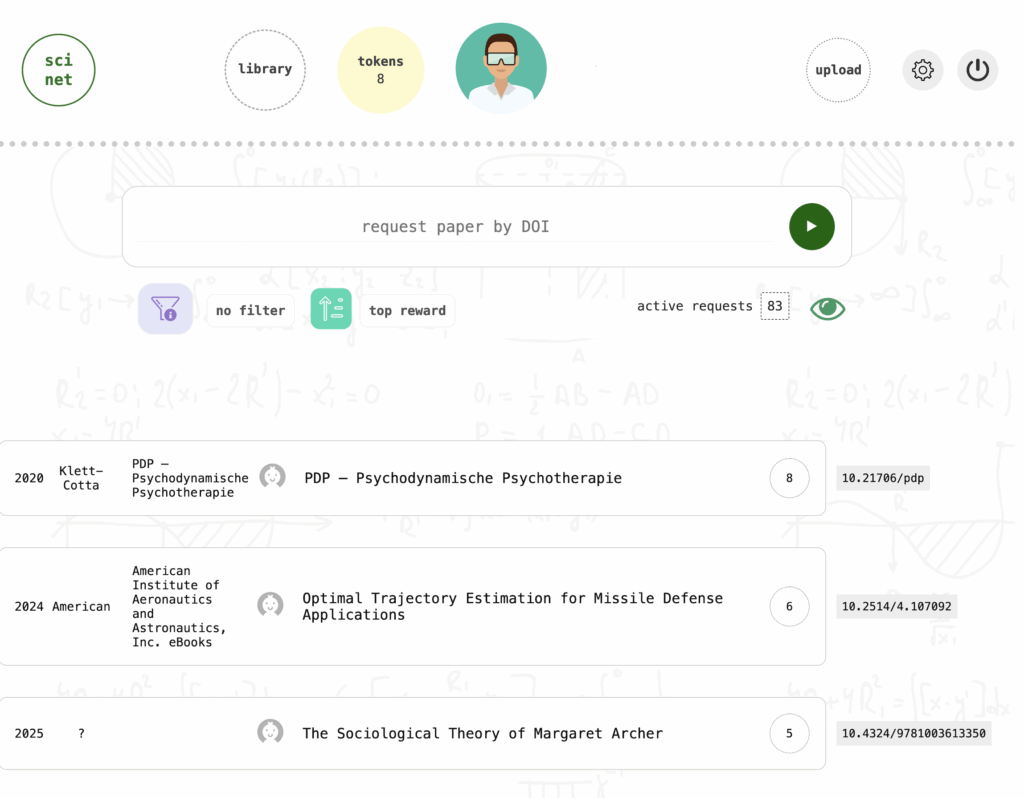
Sci-Net is a community-driven platform where users can request academic papers and books they can’t access elsewhere. It runs on a reward system: you post a request with a bounty in $Sci-Hub (SCI) tokens, and another member of the community fulfills it.
How It Works
Here’s the basic flow:
A user needs a paper they can’t access.
They post a request on Sci-Net, attaching a reward in SCI tokens (minimum: 1 token).
The system checks whether the paper is already in Sci-Hub’s database using its DOI. If it is, the request is closed automatically. If not, it goes live on the platform.
Another user picks up the request and has 30 minutes to upload the document.
The requester reviews the file and approves it. Once approved, the reward is released to the uploader — and the paper is added to Sci-Hub’s database, where anyone can download it for free.
This peer-to-peer loop solves the post-2022 paper gap while simultaneously expanding Sci-Hub’s repository over time.
A Note on Privacy
Sci-Net takes anonymity seriously. You don’t need an email address to sign up. On top of that, before any paper becomes available for download, the platform’s algorithm scans the PDF and strips out watermarks — those hidden identifiers that reveal the IP address or institution name of whoever originally downloaded the file.
How to Join Sci-Net
Unlike Sci-Hub, Sci-Net requires an account. And to create one, you’ll need an invitation code — which is where things get slightly technical if you’re new to crypto.
Here’s the step-by-step process:
Step 1 — Install the Phantom Wallet
Download and install Phantom from phantom.com. It’s available as a mobile app and a browser extension. The official Sci-Net documentation recommends Phantom as the primary wallet.
Step 2 — Buy Solana (SOL)
Inside the Phantom app, purchase at least 0.035 SOL (roughly $5 USD) using one of the available payment methods: MoonPay, Apple Pay, or Google Pay. This is the base currency you’ll need for the next step.
Step 3 — Swap SOL for $Sci-Hub (SCI) Tokens
Once you have SOL in your wallet, swap it for $Sci-Hub (SCI) tokens — either directly inside the Phantom app or through sci-net.xyz/exchange. These tokens will serve as your currency within the Sci-Net platform.
Step 4 — Generate Your Invitation Code
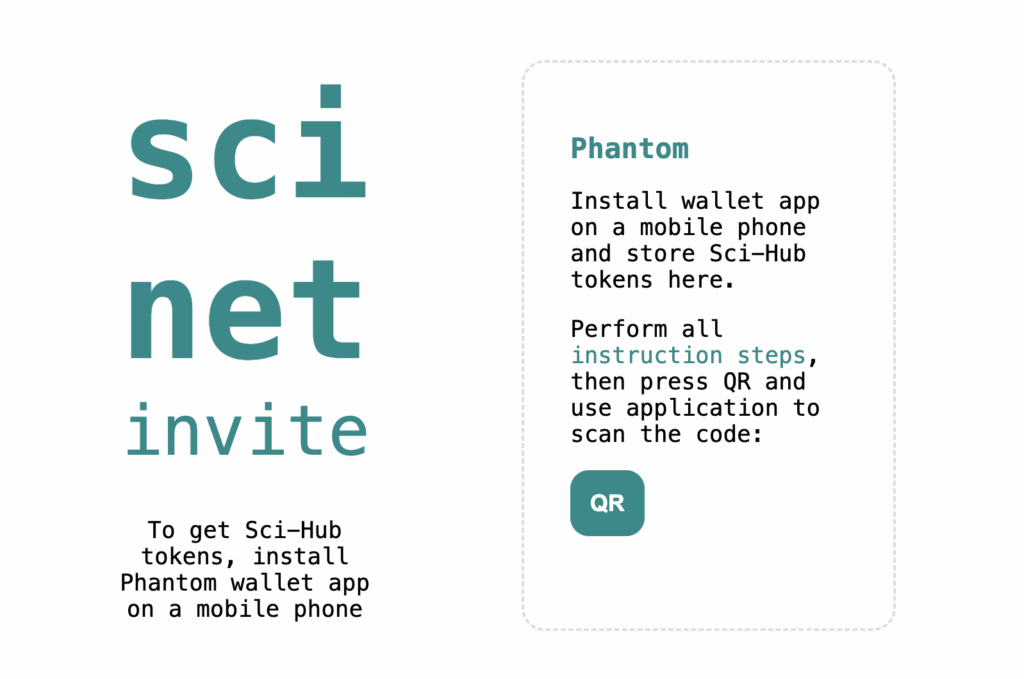
Go to sci-net.xyz/invite and click the QR button. Scan the QR code with your Phantom wallet app and follow the prompts to complete a small transaction. Your invitation code will appear on the same page shortly after.
⚠️ Important: The QR code expires in 8 minutes. If you don’t use it in time, simply generate a new one.
Step 5 — Create Your Account
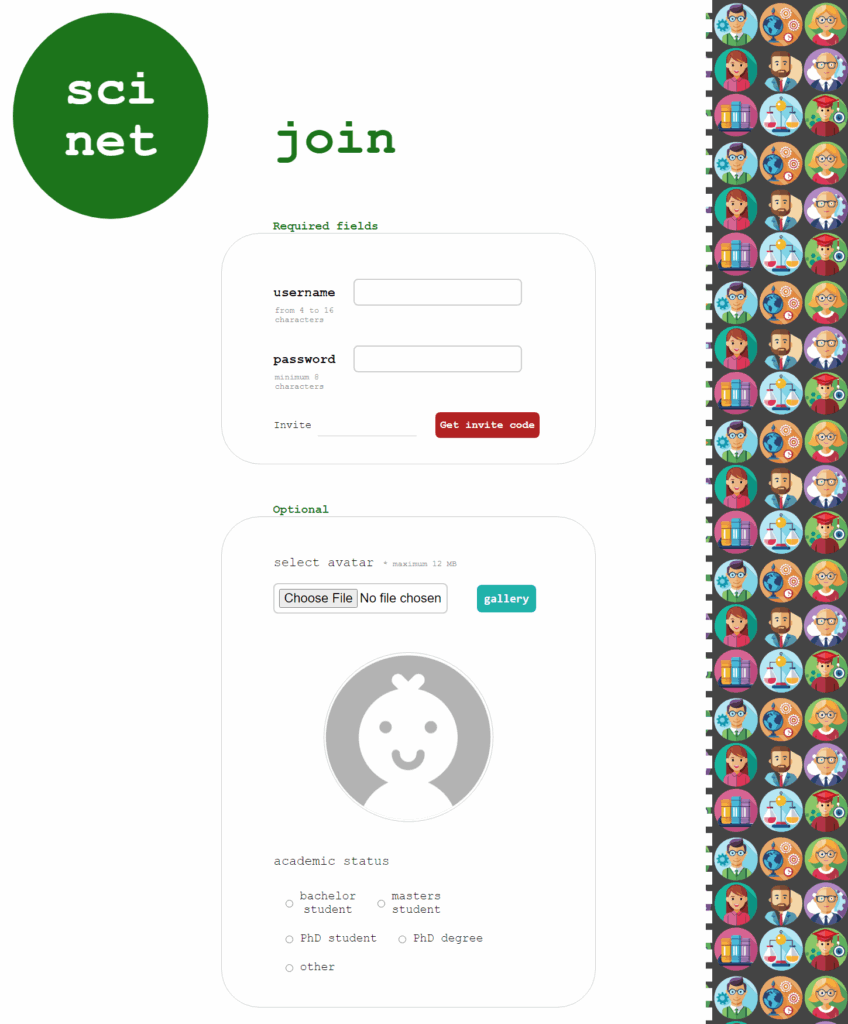
Head to sci-net.xyz/join and enter your chosen username, a password, and the invitation code from the previous step. That’s it — no email required.
You’re now part of the Sci-Net community. The SCI tokens you purchased can be used to request papers or earned by fulfilling other users’ requests.
Generating the Code from Other Wallets
The invitation code generator originally only worked with Phantom. Following an update announced by Alexandra Elbakyan on X (@ringo_ring), it now supports any wallet that can hold $Sci-Hub (SCI) tokens. Detailed instructions are available at sci-net.xyz/invite/create.
Using Bitso?
If you already use Bitso — one of the most popular crypto exchanges in Latin America — you can buy Solana there and send it to your Phantom wallet. Keep in mind that Bitso doesn’t list the $Sci-Hub (SCI) token directly, so you’ll still need Phantom to complete the swap and generate your invitation code.
References
Baydakova, A. (2021). Blackballed by PayPal, Scientific-Paper Pirate Takes Bitcoin Donations.