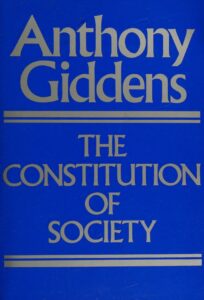
Anthony Giddens has been in the forefront of developments in social theory for the past decade. In The Constitution of Society he outlines full statement of a major new in social thought, a synthesis and elaboration of ideas touched on in previous works but described here for the first time in an integrated and comprehensive form.
Publisher
University of California Press
ISBN
9780520057289
Year
1986
Pages
402
Summary
The backdrop to The Constitution of Society is to be found in a series of significant developments which have taken place in the social sciences over the past decade and a half. These have been concentrated in substantial part in social theory, and bear especially upon that most maligned and most provocative of the social sciences, sociology.
Sociology is by its very nature controversial. However, for a considerable period after the Second World War, particularly in the English-speaking world, there was a broad consensus about its nature and tasks and about those of the social sciences as a whole. There was, it could be said, a middle ground shared by otherwise competing perspectives, a terrain on which intellectual battles could be fought out.
During that period sociology was an academic growth area, a subject with a burgeoning reputation, even if it remained distinctly unpopular in many circles. It was dominated internationally by American sociology, and in social theory the influence of Talcott Parsons was marked. The prestige enjoyed by Parsons’s ideas can be exaggerated retrospectively—many found his taste for abstraction and obscurity unattractive, and he had his fair share of critics and detractors.
However, The Structure of Social Action, first published in the late 1930s but widely known only in the post-war period, was in more than one way a key work in the formation of modern sociology. In it Parsons established a systematic pedigree for social theory, based upon an interpretation of European thought in the nineteenth and early twentieth centuries. The work of Durkheim, Max Weber and Pareto loomed large, but Marx played a very slight role indeed. The writings of the 1890–1920 generation had supposedly gone beyond Marx in all important respects, sifting out what was valuable and discarding the dross.
The book also set up an approach to social theory of a very definite type, combining a sophisticated version of functionalism and a naturalistic conception of sociology.
Contents
Elements of the Theory of Structuration
The Agent, Agency
Agency and Power
Structure, Structuration
The Duality of Structure
Forms of Institution
Time, the Body, Encounters
Consciousness, Self and Social Encounters
Reflexivity, Discursive and Practical Consciousness
The Unconscious, Time, Memory
Erikson: Anxiety and Trust
Routinization and Motivation
Presence, Co-Presence and Social Integration
Goffman: Encounters and Routines
Seriality
Talk, Reflexivity
Positioning
Critical Notes: Freud on Slips of the Tongue
Time, Space and Regionalization
Time-Geography
Critical Comments
Modes of Regionalization
Front Regions, Back Regions
Disclosure and Self
Regionalization as Generic
Time, Space, Context
Against ‘Micro’ and ‘Macro’: Social and System Integration
Critical Notes: Foucault on Timing and Spacing
Structure, System, Social Reproduction
Societies, Social Systems
Structure and Constraint: Durkheim and Others
Three Senses of ‘Constraint’
Constraint and Reification
The Concept of Structural Principles
Structures, Structural Properties
Contradiction
Making History
Critical Notes: ‘Structural Sociology’ and Methodological Individualism
Blau: a Version of Structural Sociology
An Alternative? Methodological Individualism
Change, Evolution and Power
Evolutionism and Social Theory
Adaptation
Evolution and History
Analysing Social Change
Change and Power
Critical Notes: Parsons on Evolution
Structuration Theory, Empirical Research and Social Critique
A Reiteration of Basic Concepts
The Analysis of Strategic Conduct
Unintended Consequences: Against Functionalism
The Duality of Structure
The Problem of Structural Constraint
Contradiction and the Empirical Study of Conflict
Institutional Stability and Change
Drawing Together the Threads: Structuration Theory and Forms of Research
Mutual Knowledge versus Common Sense
Generalizations in Social Science
The Practical Connotations of Social Science
Critical Notes: Social Science, History and Geography
Glossary
Bibliography
Index
Extract
In offering a preliminary exposition of the main concepts of structuration theory, it will be useful to begin from the divisions which have separated functionalism (including systems theory) and structuralism on the one hand from hermeneutics and the various forms of "interpretative sociology" on the other. Functionalism and structuralism have some notable similarities, in spite of the otherwise marked contrasts that exist between them. Both tend to express a naturalistic standpoint, and both are inclined towards objectivism.
Functionalist thought, from Comte onwards, has looked particularly towards biology as the science providing the closest and most compatible model for social science. Biology has been taken to provide a guide to conceptualizing the structure and the functioning of social systems and to analysing processes of evolution via mechanisms of adaptation. Structuralist thought, especially in the writings of Lévi-Strauss, has been hostile to evolutionism and free from biological analogies.
Here the homology between social and natural science is primarily a cognitive one in so far as each is supposed to express similar features of the overall constitution of mind. Both structuralism and functionalism strongly emphasize the pre-eminence of the social whole over its individual parts (i.e., its constituent actors, human subjects).
In hermeneutic traditions of thought, of course, the social and natural sciences are regarded as radically discrepant. Hermeneutics has been the home of that "humanism" to which structuralists have been so strongly and persistently opposed. In hermeneutic thought, such as presented by Dilthey, the gulf between subject and social object is at its widest. Subjectivity is the preconstituted...
Author
Anthony Giddens (born 1938) is a renowned British sociologist, former Director of the London School of Economics, and a pivotal figure in modern social theory known for his Theory of Structuration and his political philosophy, "The Third Way." Throughout his distinguished career, he authored influential works such as Capitalism and Modern Social Theory (1971), The Constitution of Society (1984), The Consequences of Modernity (1990), and The Third Way: The Renewal of Social Democracy (1998), profoundly shaping contemporary political thought and sociology globally.