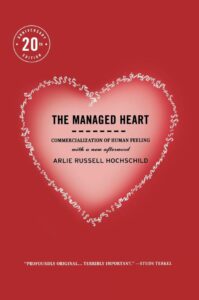
In The Managed Heart, Arlie Hochschild introduces “emotional labor”—the commercialization of human feelings in service jobs. Focusing on flight attendants and collectors, she shows how forcing workers to manage their emotions for a wage leads to burnout, alienation, and self estrangement.
Publisher
University of California Press
ISBN
0520239334
Year
2003
Pages
327
Summary
In The Managed Heart: Commercialization of Human Feeling, sociologist Arlie Russell Hochschild explores how the modern service economy commodifies personal emotions, introducing the seminal concept of emotional labor. Hochschild defines emotional labor as the management of feeling to create a publicly observable facial and bodily display, which is sold for a wage and holds exchange value in the marketplace.
Drawing on extensive field research—primarily focusing on flight attendants trained to radiate warmth and debt collectors trained to project urgency—Hochschild contrasts private emotional management with its commercial use. In daily life, people manage emotions according to social “feeling rules” to show respect or gratitude. However, when corporations mandate these emotional displays, worker feelings become a product engineered for profit.
To meet job demands, workers employ two main techniques: surface acting, where they feign expressions without changing inner feelings, and deep acting, where they actively manipulate their thoughts and memories to experience the required emotion genuinely. Over time, performing continuous emotional labor forces workers to suppress their authentic emotional responses, leading to severe psychological consequences.
Hochschild highlights the risks of emotional burnout, self-estrangement, and alienation. When feelings become tools for efficiency, employees struggle to distinguish genuine personal emotions from commercialized performances. Additionally, she emphasizes the gendered nature of this labor, noting that women are disproportionately expected to perform emotional tasks due to historical social conditioning and status expectations.
Ultimately, The Managed Heart offers a vital critique of modern capitalism, demonstrating how corporate control has expanded beyond physical energy to commercialize human emotion, forever altering our relationship with our own feelings.
Contents
PART ONE/PRIVATE LIFE
1 Exploring the Managed Heart
2 Feeling as clue
3 Managing Feeling
4 Feeling Rules
5 Paying Respects with Feeling: The Gift Exchange
PART TWO/PUBLIC LIFE
6 Feeling Management: From Private to Commercial Uses
7 Between the Toe and the Heel: Jobs and Emotional Labor
8 Gender, Status, and Feeling
9 The Search for Authenticity
Afterword to the Twentieth Anniversary Edition
APPENDIXES
A. Models of Emotion: From Darwin to Goffman
B. Naming Feeling
C. Jobs and Emotional Labor
D. Positional and Personal Control Systems
Notes
Bibliography to the Twentieth Anniversary Edition
Bibliography
Extract
I think my interest in how people manage emotions began when my parents joined the U.S. Foreign Service. At the age of twelve, I found myself passing a dish of peanuts among many guests and looking up at their smiles; diplomatic smiles can look different when seen from below than when seen straight on. Afterwards I would listen to my mother and father interpret various gestures. The tight smile of the Bulgarian emissary, the averted glance of the Chinese consul, and the prolonged handshake of the French economic officer, I learned, conveyed messages not simply from person to person but from Sofia to Washington, from Peking to Paris, and from Paris to Washington. Had I passed the peanuts to a person, I wondered, or to an actor? Where did the person end and the act begin? Just how is a person related to an act?
As a graduate student at Berkeley some years later, I was excited by the writings of C. Wright Mills, especially his chapter in White Collar called "The Great Salesroom," which I read and reread, I see now, in search of answers to those abiding questions. Mills argued that when we "sell our personality" in the course of selling goods or services we engage in a seriously self-estranging process, one that is increasingly common among workers in advanced capitalist systems. This had the ring of truth, but something was missing. Mills seemed to assume that in order to sell personality, one need only have it. Yet simply having personality does not make one a diplomat, any more than having muscles makes one an athlete. What was missing was a sense of the active emotional labor involved in the selling.
Author
Arlie Russell Hochschild is an influential American sociologist and professor emeritus at UC Berkeley, renowned for pioneering the study of emotional labor. Her groundbreaking works include The Managed Heart, The Second Shift, The Time Bind, and Strangers in Their Own Land, a National Book Award finalist that offers profound insights into modern political divides.