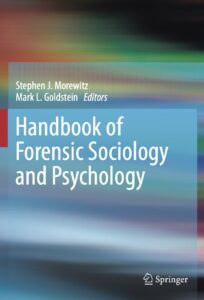
Handbook of Forensic Sociology and Psychology Morewitz and Goldstein
Overview
The Handbook of Forensic Sociology and Psychology examines the roles
of sociologists and psychologists as expert witnesses and consultants in different civil, criminal, and immigration cases. It will show how forensic sociology and forensic psychology principles, theories, and methods can be used in a variety of areas such as personal injury, child custody, and employment.
Publisher
Springer
ISBN
9781461471776
Year
2014
Pages
466
Summary
Over the past few decades, the role of forensic sociology and forensic psychology has expanded in the US court system. This is the first handbook that will analyze the principles, theories, and methods of both forensic sociology and psychology and their use in the justice system.
The Handbook of Forensic Sociology and Psychology examines the roles of sociologists and psychologists as expert witnesses and consultants in different civil, criminal, and immigration cases. It will show how forensic sociology and forensic psychology principles, theories, and methods can be used in a variety of areas such as personal injury, child custody, and employment. In addition, forensic sociologists and psychologists testify as expert witnesses and provide technical consultations on diverse issues ranging from personal injury and premises liability to political asylum and environmental disasters.
Based on their research and training in specialized areas of sociology and psychology as well as in quantitative and qualitative research methods, sociologists and psychologists assist attorneys and law firms by offering expert testimony about different aspects of litigation. Social and behavioral scientists can assist organizations and policy makers in developing appropriate organizational, individual, family, and other settings.
As consultants, they can help attorneys and law firms by conducting experiments, constructing juror questionnaires and interview protocols for the voir dire, designing case-specific juror profiles, conducting mock trials, assisting in preparing strategies and research for depositions, and observing trials and providing feedback during trials.
Contents
Evolving Practice Parameters of Forensic Criminology
Daniel B. Kennedy
The Work of the Sociologist as Mitigation Expert in Cases of Violent Crime
Craig J. Forsyth
“Oh, Stop That Cursed Jury”: The Role of the Forensic Psychologist in the Mitigation Phase of the Death Penalty Trial
Valerie McClain, Elliot Atkins, and Michael L. Perlin
The Problem of Interrogation-Induced False Confession: Sources of Failure in Prevention and Detection
Deborah Davis and Richard A. Leo
‘Brainwashing’ as Forensic Evidence
James T. Richardson
Target Selection by Criminal Groups and Gangs
Rosemary J. Erickson and Sandra J. Erickson
Gangs in the Workplace
Michael J. Witkowski
The Role of a Gang Expert in Court
Lisa Taylor-Austin
Competence to Proceed and Juvenile Courts
Daniel L. Davis and Terrance J. Kukor
Competency Evaluations for Adult Defendants
Daisy Switzer
Forensic Neuropsychological Evaluation of Hispanics
Inés Monguió
Sociological Testimony in Employment- and Education-Related Litigation
Stephen J. Morewitz
Preventing Workplace Violence and Litigation Through Preemployment Screening and Enforcement of Workplace Conduct Expectations
Tessa Sugahara and Kenji Sugahara
Critical Issues in the Evolving Diagnosis of PTSD
John P. Bair and Kathleen M. Long
Sociological Evidence in Suicide Litigation
Stephen J. Morewitz
Sociological Data in Malpractice Lawsuits
Stephen J. Morewitz
Sociological Testimony in Long-Term Care Litigation
Stephen J. Morewitz
Sociological Testimony and Evidence in Product Liability Litigation
Stephen J. Morewitz
Sociological Evidence in Human Factors-Related Litigation
Stephen J. Morewitz
Sociological Testimony in Alcohol- and Other Drug-Associated Litigation
Stephen J. Morewitz
Sociological Theory and Methods in Toxic Tort Lawsuits
Stephen J. Morewitz
Child Custody Evaluations
Mark L. Goldstein
Parental Alienation
Demosthenes Lorandos
Anger
A. Antonio González-Prendes
Forensic Evaluation of Child Abuse
Daniel S. Lobel
Sociological Evidence in Abuse Litigation
Stephen J. Morewitz
Using Expert Witnesses in Immigration Hearings/Court
Philip M. Levin and Stephen J. Morewitz
Forensic Sociology: The Case of Honor Killing in the Muslim World
Shaul Gabbay
Courting Media: Mass Media Studies of Immigration Courts
Katherine R. Abbott
Sociological Evidence in Courts-Martial Pertaining to War Crimes
Stjepan G. Mestrovic
Gender Matters! Socio-Legal Studies, Courts-Martial, and the US Military
Ryan Ashley Caldwell
Extract
Chapter 1: Dr. Daniel B. Kennedy describes forensic criminology as the application of criminological knowledge to issues before the courts. Forensic criminology includes the scientific study of the making of law, the breaking of law, and societal reactions to the breaking of law.
Chapter 2: Dr. Craig J. Forsyth describes the use of sociology as mitigation in criminal cases. He also addresses the different styles of mitigation and theories he has used. The subculture of violence as an example of theory is used as an example of his recent testimony in the sentencing of a murder case. The author has worked in over 300 violent crime cases since 1988, most of which were capital murder, but also include second-degree murder, manslaughter, armed robbery, and rape.
Chapter 3: Dr. Valerie McClain, Dr. Elliot Atkins, and Professor Michael L. Perlman analyze the role of the forensic psychologist in the mitigation phase of a death penalty trial. The authors assess the development of Supreme Court case law in this area and analyze the structure of constitutionally acceptable statutes, focusing on the roles of aggravators and mitigators. The authors evaluate the role of the forensic expert in presenting mitigation evidence, the meaning of mitigation, how mitigation evidence may be gathered (with special attention being paid to issues of neuroscience evidence), report writing, and the preparation of mitigation testimony. They analyze some of the special issues related to mitigation, including adequacy of counsel, prohibitions against executing defendants with severe mental impairments, the dilemma of “death qualified” juries, and the use of forensic witnesses by the prosecution. Finally, the authors provide some modest suggestions for enhancing this area of forensic area.
Chapter 4: Dr. Richard A. Leo and Dr. Deborah Davis analyze the problem of interrogation-induced false confession, focusing on the sources of failure in prevention and detection. The authors evaluate why do false confessions occur, and what can be done to prevent them? In addition, Drs. Leo and Davis analyze why these false confessions remain undetected once elicited, and what can be done to more successfully identify them when they do occur? In addressing each question, the authors focus on the role of failures of relevant knowledge and understanding among those who elicit and misjudge false confessions.
Chapter 5: Dr. James T. Richardson evaluates the meanings attached to the concept of brainwashing, critiques those uses of the term, assesses the concept from the perspective of rules of evidence, and offers alternative explanations about how and why young people in America and other societies have chosen to participate in new religions.
Other chapters analyze additional forensic areas, including the use of sociological testimony in litigation involving human factor issues, abuse, partner violence, suicides, alcohol and other drugs, medical malpractice, product liability, and toxic tort and the role of psychological testimony in competency evaluations, child custody, parental alienation, and child abuse cases.
Author
Stephen J. Morewitz, lecturer in the CSUEB Department of Nursing and Health Sciences, won the San Jose State University Annual Author Awards 2013 for co-editing the Handbook of Forensic Sociology and Psychology (New York: Springer, 2013) with Mark L. Goldstein, Ph.D.
Morewitz is the author of more than 100 publications, including the award-winning book, Stalking and Violence (New York: Kluwer/Plenum, 2003), the award-winning book, Domestic Violence and Maternal and Child Health (New York: Springer, 2004),Chronic Disorders in Children and Adolescents (New York: Springer, 2011), Chronic Diseases and Health Care (New York, Springer, 2006), and Aging and Chronic Disorders (New York, Springer 2008) with Mark L. Goldstein.