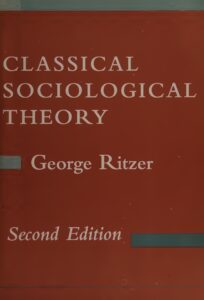
George Ritzer’s Classical Sociological Theory explores the core ideas of key thinkers like Marx, Durkheim, Weber, and Simmel. It traces sociology’s European origins, highlights marginalized female theorists, and explains how these classic frameworks shape contemporary social analysis.
Publisher
MacGraw-Hill
ISBN
0070530173
Year
1996
Pages
532
Summary
The second edition of Classical Sociological Theory involves two major additions and many more modest alterations. One primary addition is a new chapter devoted to the work of Karl Mannheim. While several other classical thinkers could have received chapter-length treatment, Mannheim was chosen for several reasons. First, the nature and scope of his thinking clearly place him in the classical tradition. Second, his theorizing about rationality seems particularly important and useful given the current high level of interest in this topic in sociology. Finally, and most important, he continues to be the dominant figure in the history of the still-vibrant sociology of knowledge. The second major addition is a chapter written by Patricia Madoo Lengermann and Jill Niebrugge on the contributions of several women to classical theory. This is a long-overdue attempt to recognize the contributions of females to the development of sociological theory.
By classical sociological theory we mean theories of great scope and ambition that either were created during sociology’s classical age in Europe (roughly the early 1800s through the early 1900s) or had their roots in that period and culture. The theories of Comte, Spencer, Marx, Durkheim, Weber, Simmel, and Mannheim were produced during the classical age largely in France, England, and Germany. The theories of Mead, Schutz, and Parsons were largely produced later and mainly in the United States, but they had most of their sources in the classical age and in European intellectual traditions.
The work of these theorists is discussed in this book for two basic reasons. First, in all cases their work was important in its time and played a central role in the development of sociology in general and sociological theory in particular. Second, their ideas continue to be relevant to, and read by, contemporary sociologists, although this is less true of the work of Comte and Spencer (who are of more historical significance) than it is of the others.
Classical Sociological Theory does not deal with all sociological theory but rather with classical theory. However, in order to better understand the ideas of the classical theorists to be discussed in depth throughout this book, we begin with two chapters that offer an overview of the entire history of sociological theory. Chapter 1 deals with the early years of sociological theory, while Chapter 2 brings that history up to the present day and to the most recent developments in sociological theory. Taken together, these two chapters offer the context within which the work of the classical theorists is to be understood. The two introductory chapters are animated by the belief that it is important to understand not only the historical sources of classical theories but also their later impact. More generally, the reader should have a broad sense of sociological theory before turning to a detailed discussion of the classical theorists. The remainder of the body of this book (Chapters 3 through 13) deals with the ideas of the major classical theorists. Thus, the ideas of the major classical theorists will be discussed twice. They will be introduced very briefly in either the first or second chapter in their historical context, and they will be discussed in great depth in the chapter devoted to each of the theorists.
Why focus on these theorists and not the innumerable others whose names and ideas will arise in the course of these first two chapters? The simplest answer to this question is that space limitations make it impossible to deal with all classical theorists. Beyond that, many theorists are not given full-chapter treatment because their theories do not belong to, or have centrally important roots in, the classical age. Furthermore, to be discussed in depth, theories must meet a series of other criteria. That is, to be included, theories must have a wide range of application, must deal with centrally important social issues, and must have stood up well under the test of time (that is, they must continue to be read and to be influential). Thus, a number of theorists who are briefly discussed in this chapter (for example, Louis DeBonald and Gaetano Mosca) will not be discussed in detail later because their ideas do not meet one or more of the criteria listed above, especially the fact that their theories have not stood the test of time. A number of the more contemporary theorists discussed in Chapter 2 (for example, Erving Goffman and Harold Garfinkel) are not discussed further later in the book because they are associated more with the modern era than with classical sociological theory.
Our focus is on the important classical theoretical work of sociologists, as well as on work which has been done by those who are often associated with other fields (for example, Karl Marx and his association with the field of economics) but which has come to be defined as important in sociology. To put it succinctly, this is a book about the “big ideas” in the history of sociology, ideas that deal with major social issues and are far-reaching in their scope.
In addition to the theorists mentioned above, Chapter 9 is devoted to a number of early female theorists—especially, Harriet Martineau, Charlotte Perkins Gilman, Jane Addams, Anna Julia Cooper, Ida Wells-Barnett, Marianne Weber, and Beatrice Potter Webb. Because their contributions are only now being recognized, they do not fit fully the profile of classical sociological theory outlined in the last few paragraphs. On the one hand, they are clearly classical thinkers who worked in the same time frame as the male theorists previously mentioned. In the main, their theories have a wide range of application and have certainly addressed centrally important issues. They were either sociologists or nonsociologists whose work is coming to be seen as important in sociology. On the other hand, one cannot say that their work has stood the test of time. The fact is that as a result of discrimination against women, they were not widely read or highly influential in their own time let alone ours. Nevertheless, they are included in this book because of the belief that as their work is rediscovered and read, their influence will grow in future years. As with the male theorists, these female theorists have produced a set of “big ideas.”
Contents
A Historical Sketch of Sociological Theory: The Early Years
Introduction
Social Forces in the Development of Sociological Theory
Political Revolutions
The Industrial Revolution and the Rise of Capitalism
The Rise of Socialism
Feminism
Urbanization
Religious Change
The Growth of Science
Intellectual Forces and the Rise of Sociological Theory
The Enlightenment and the Conservative Reaction to It
The Development of French Sociology
The Development of German Sociology
The Origins of British Sociology
Key Figures in Italian Sociology
Turn-of-the-Century Developments in European Marxism
The Contemporary Relevance of Classical Sociological Theory
A Historical Sketch of Sociological Theory: The Later Years
Early American Sociological Theory
Politics
Social Change and Intellectual Currents
The Chicago School
Women in Early Sociology
Sociological Theory to Mid-Century
The Rise of Harvard, the Ivy League, and Structural Functionalism
The Chicago School in Decline
Developments in Marxian Theory
Karl Mannheim and the Sociology of Knowledge
Sociological Theory from Mid-Century
Structural Functionalism: Peak and Decline
Radical Sociology in America: C. Wright Mills
The Development of Conflict Theory
The Birth of Exchange Theory
Dramaturgical Analysis: The Work of Erving Goffman
The Development of Sociologies of Everyday Life
The Rise and Fall (?) of Marxian Sociology
The Challenge of Feminist Theory
Structuralism and Poststructuralism
Sociological Theory in the 1980s and 1990s
Micro-Macro Integration
Agency-Structure Integration
Theoretical Syntheses
Metatheorizing in Sociology
Social Theory: Toward the Fin de Siecle
The Defenders of Modernity
The Proponents of Postmodernity
Multicultural Social Theory
Auguste Comte
Comte's Profound Ambitions
Positivism: The Search for Invariant Laws
Law of the Three Stages
Positivism: The Search for Order and Progress
Comte's Sociology
Social Statics
Social Dynamics
Theory and Practice
Comte's Plans for the Future
Comte: A Critical Assessment
Positive Contributions
Basic Weaknesses in Comte's Theory
Herbert Spencer
Spencer and Comte
General Theoretical Principles
Sociology
Defining the Science of Sociology
Sociological Methods
The Evolution of Society
Simple and Compounded Societies
Militant and Industrial Societies
The Evolution of Societal Institutions
Domestic Institutions
Ceremonial Institutions
Political Institutions
Ecclesiastical Institutions
Professional Institutions
Industrial Institutions
Ethics and Politics
Karl Marx
The Dialectic
Human Potential
Powers and Needs
Consciousness
Activity
Sociability
Unanticipated Consequences
Alienation
Components of Alienation
Distortions Resulting from Alienation
Emancipation
The Structures of Capitalist Society
Commodities
Capital
Private Property
Division of Labor
Social Class
Cultural Aspects of Capitalist Society
Class Consciousness and False Consciousness
Ideology
Marx's Economics: A Case Study
Emile Durkheim
Social Facts
The Division of Labor in Society
Dynamic Density
Law
Anomie
Collective Conscience
Collective Representations
Suicide and Social Currents
The Four Types of Suicide
A Group Mind?
Religion
Sacred and Profane
Totemism
Collective Effervescence
Social Reformism
Occupational Associations
Cult of the Individual
The Actor in Durkheim's Thought
Assumptions about Human Nature
Socialization and Moral Education
Dependent Variables
Individual Action and Interaction
Early and Late Durkheimian Theory
Max Weber
Methodology
History and Sociology
Verstehen
Causality
Ideal Types
Values
Substantive Sociology
What Is Sociology?
Social Action
Class, Status, and Party
Structures of Authority
Rationalization
Religion and the Rise of Capitalism
Georg Simmel
Primary Concerns
Dialectical Thinking
Individual Consciousness
Social Interaction ("Association")
Interaction: Forms and Types
Social Structures
Objective Culture
The Philosophy of Money
The Tragedy of Culture in Its Broader Context
Secrecy: A Case Study in Simmel's Sociology
Early Women Sociologists and Classical Sociological Theory: 1830–1930 (Patricia Madoo Lengermann and Jill Niebrugge)
Harriet Martineau (1802–1876)
Charlotte Perkins Gilman (1860–1935)
Jane Addams and the Women of Chicago
Jane Addams (1860–1935)
The Women of Chicago
Anna Julia Cooper (1859–1964) and Ida Wells-Barnett (1862–1931)
Marianne Schnitger Weber (1870–1954)
Beatrice Potter Webb (1858–1943)
Karl Mannheim
The Sociology of Knowledge
The Sociology of Knowledge and the Theory of Ideology
A Sociological Approach
Ideology and Utopia
Ideology
Utopia
Conservatism
Rationality and the Irrationality of the Times
Planning and Social Reconstruction in the Modern World
A Critical Analysis of Mannheim's Work
George Herbert Mead
The Priority of the Social
The Act
Gestures
Significant Symbols
Mental Processes and the Mind
Self
Society
Evolution
Dialectical Thinking
Alfred Schutz
Interpretations of Schutz's Work
The Ideas of Edmund Husserl
Science and the Social World
Typifications and Recipes
The Life-World
Intersubjectivity
Private Components of Knowledge
Realms of the Social World
Folgewelt and Vorwelt
Umwelt and We Relations
Mitwelt and They Relations
Consciousness, Meanings, and Motives
Interpreting Schutzian Theory
Talcott Parsons
Parsons's Integrative Efforts
General Principles
Philosophical and Theoretical Roots
Action Theory
The Turn Away from Action Theory
Pattern Variables
AGIL
Consistency in Parsonsian Theory: Integration and Order
The Action System
Social System
Cultural System
Personality System
Behavioral Organism
Change and Dynamism in Parsonsian Theory
Evolutionary Theory
Generalized Media of Interchange
Appendix: Sociological Metatheorizing and a Metatheoretical Schema for Analyzing Sociological Theory
Metatheorizing in Sociology
The Gains from Metatheorizing
The Critics of Metatheorizing
The Current Explosion of Interest in Metatheorizing
Factors Involved in the Maturation of Metatheorizing
Pierre Bourdieu's "Socioanalysis"
The Ideas of Thomas Kuhn
Sociology: A Multiple-Paradigm Science
Major Sociological Paradigms
Toward a More Integrated Sociological Paradigm
Levels of Social Analysis: A Review of the Literature
Levels of Social Analysis: A Model
Extract
SOCIAL FORCES IN THE DEVELOPMENT OF SOCIOLOGICAL THEORY
All intellectual fields are profoundly shaped by their social settings. This is particularly true of sociology, which is not only derived from that setting but takes the social setting as its basic subject matter. We will focus briefly on a few of the most important social conditions of the nineteenth and early twentieth centuries, conditions that were of the utmost significance in the development of sociology. We also will take the occasion to begin introducing the major figures in the history of sociological theory.
Political Revolutions
The long series of political revolutions ushered in by the French Revolution in 1789 and carrying over through the nineteenth century was the most immediate factor in the rise of sociological theorizing. The impact of these revolutions on many societies was enormous, and many positive changes resulted. However, what attracted the attention of many early theorists was not the positive consequences, but the negative effects of such changes. These writers were particularly disturbed by the resulting chaos and disorder, especially in France. They were united in a desire to restore order to society. Some of the more extreme thinkers of this period literally wanted a return to the peaceful and relatively orderly days of the Middle Ages. The more sophisticated thinkers recognized that social change had made such a return impossible. Thus they sought instead to find new bases of order in societies that had been overturned by the political revolutions of the eighteenth and nineteenth centuries. This interest in the issue of social order was one of the major concerns of classical sociological theorists, especially Comte, Durkheim, and Parsons.
The Industrial Revolution and the Rise of Capitalism
At least as important as political revolution in the shaping of sociological theory was the Industrial Revolution, which swept through many Western societies, mainly in the nineteenth and early twentieth centuries. The Industrial Revolution was not a single event but many interrelated developments that culminated in the transformation of the Western world from a largely agricultural to an overwhelmingly industrial system. Large numbers of people left farms and agricultural work for the industrial occupations offered in the burgeoning factories. The factories themselves were transformed by a long series of technological improvements. Large economic bureaucracies arose to provide the many services needed by industry and the emerging capitalist economic system.
Author
GEORGE RITZER is Professor of Sociology at the University of Maryland. His major areas of interest are sociological theory and the sociology of work. He has served as Chair of the American Sociological Association’s Sections on Theoretical Sociology (1989-1990) and Organizations and Occupations (1980-1981). Professor Ritzer has been Distinguished Scholar-Teacher at the University of Maryland and has been awarded a Teaching Excellence award. He has held the UNESCO Chair in Social Theory at the Russian Academy of Sciences and a Fulbright-Hays Fellowship. He has been Scholar-in-Residence at the Netherlands Institute for Advanced Study and the Swedish Collegium for Advanced Study in the Social Sciences.
Dr. Ritzer’s main theoretical interests lie in metatheory as well as in the theory of rationalization. In metatheory, his most recent book is Metatheorizing in Sociology (Lexington Books, 1991). Earlier books on this topic include Sociology: A Multiple Paradigm Science (1975, 1980) and Toward an Integrated Sociological Paradigm (1981). He has written a number of essays on rationalization as well as The McDonaldization of Society (Pine Forge Press, 1993). Professor Ritzer is also the author of a more recent work in applied social theory, Expressing America: A Critique of the Global Credit Card Society (Pine Forge Press, 1995). Professor Ritzer’s work has been translated into a number of languages, including Chinese, Croatian, Danish, German, Farsi, Italian, Korean, Russian, and Spanish.
In 1996 McGraw-Hill will publish the fourth editions of Professor Ritzer’s basic text Sociological Theory and his Modern Sociological Theory. In 1997 McGraw-Hill will publish his Postmodern Social Theory.
Book Details
Title
Classical Sociological Theory
Author
George Ritzer
Publisher
MacGraw-Hill
Year
1996
Pages
532
Country
United States of America
ISBN
0070530173
Format
PDF
Filesize
29.1 MB
Cite this book
Ritzer, G. (1996). Classical Sociological Theory. MacGraw-Hill. https://sociologiac.net/?p=24655