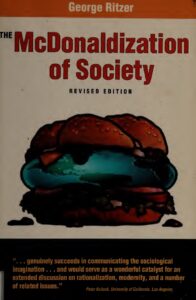
In The McDonaldization of Society, George Ritzer explores how efficiency, calculability, predictability, and control govern modern culture. Expanding on Max Weber’s rationalization, he shows how fast-food principles shape daily life, driving efficiency while risking human dehumanization.
Publisher
Pine Forge Press
ISBN
0803990766
Year
1996
Pages
292
Summary
I have been thinking about the process of rationalization for many years. It has long been believed that bureaucracy represents the ultimate form of rationalization. However, it gradually began to dawn on me that something new was on the horizon, something destined to replace the bureaucratic structure as the model for rationalization. That “something” turned out to be the fast-food restaurant, most notably McDonald’s, which revolutionized not only the restaurant business, but also American society and, ultimately, the world.
As a New Yorker, I came late to McDonald’s because, during my teenage years (the 1950s), the fast-food restaurant had not yet invaded large cities to any great degree. I can remember the first time I ever saw a McDonald’s. It was on an automobile trip to Massachusetts in 1958, and, for some reason, it left an indelible mark on my memory. Retrospectively, I think I realized, at least subliminally, that those golden arches represented something new and important.
About a decade later, and by this time a professional sociologist, I lived in New Orleans. When my brother Alan Ritzer, a lifelong New Yorker, came to visit, we went to McDonald’s, his first exposure to the fast-food restaurant. He, too, was struck by the significance of this phenomenon and of the problems it posed for society.
Through the 1970s I developed my theoretical orientation, which was heavily influenced by the work of the German social theorist Max Weber and his views about the rationalization process. He viewed bureaucracy as the paradigm case of rationality. Although Weber recognized the advantages of rationalization, he was most animated by its dangers, especially the possibility of what he called an “iron cage” of rationality. Weber felt that rational systems were inhuman and dehumanizing. He dreaded the possibility, indeed the likelihood, that an increasing number of sectors of society would become rationalized; he felt that society would ultimately become a seamless web of rational institutions. Once rational systems proliferated to that extent, we would be faced with an iron cage of rationality: there could be no escape, no exit.
By the early 1980s, I began to put Weber’s theory of rationalization together with my concern with the growth of the fast-food restaurant. By this time, McDonald’s was far more ubiquitous, and its clones in the fast-food business, as well as in many other social settings, were spreading throughout society. Alarmed by this trend, in 1983 I wrote an essay entitled, “The McDonaldization of Society.”
With the latter essay out of my system, I moved on to other things, including other applications of Weberian theory. During a speech I gave in 1990, I touched on McDonaldization in the context of a far broader discussion of the applications of Weberian theory to the modern world. I thought that the most important part of the talk was an effort to explain the rise of Japanese industry, and the decline of American industry, in terms of rationalization. However, when it came time for open discussion, the audience only wanted to talk about McDonaldization. This was clearly an idea with which people resonated. Over the years, I had received similar reactions from students whenever I lectured on McDonaldization. In fact, as McDonaldization became more and more ubiquitous, the level of interest in the phenomenon, and in the problems it generated, increased dramatically.
It seemed clear to me that it was time to write a book on the issue. In the decade since I had written my essay, fast-food restaurants had proliferated to the degree that they were virtually everywhere. Also, many other businesses had been organized along the lines developed by McDonald’s. Almost all social institutions (for example, education, sports, politics, and religion) were adapting McDonald’s principles to their operations. And McDonaldization was spreading around the world—fast-food croissanteries in Paris (of all places), Kentucky Fried Chicken in Beijing, McDonald’s in Beijing and Moscow…
The Mcdonaldization of Society is essentially a work in social criticism. McDonald’s clearly has many advantages, and they will be mentioned throughout the book. However, McDonald’s and its many clones have plenty of opportunity, and spend huge sums of money, to tell you about their good points. This book seeks to give the public discourse a little balance by focusing on the problems created, and the dangers posed, by McDonaldization.
As a theoretically based work in social criticism, this book is part of a historical tradition in the social sciences in which social theory is used to critique society and thereby to provide the base for its betterment. This tradition animated Weber as well as other social theorists such as Georg Simmel, Émile Durkheim, Karl Marx, C. Wright Mills, and Jürgen Habermas.
Testimonials
“Since using Ritzer’s text, enrollment in the class has grown from fifty to eighty-five students. My department has reviewed the text and we think it will serve as a ‘launching pad’ for our majors, something that demystifies theory and prepares students for more difficult and challenging work.”— Stephen N. Butler, Earlham College
“This book sparked the most animated response from students that I have ever experienced in the decade I have taught Sociology of Complex Organizations.”— Stephen S. Kulis, Arizona State University
“Ritzer’s text is in a class by itself. I can’t think of another as insightful and enjoyable.”— James D. Cover, Furman University
“The McDonaldization of Society presents an insightful sociological critique of American society that is written in a way introductory students can understand and enjoy.”— Fred C. Pampel, University of Colorado
“I would adopt it again in a minute, for both theory courses as well as social problems courses. It stimulates excellent discussion in the classroom and can be used as a springboard to many other themes as well.”— Stephen P. Legeay, Shaw University
“The merging of classic sociological theory with insightful observations on current society make this book a welcome alternative to the comprehensive but dull McIntro.”— John Walsh, University of Illinois, Chicago
“… an interesting, excellent, important book which raises issues that demand to be addressed for a variety of courses that deal with modernity, contemporary American culture, and society.”— Lawrence E. Mintz (American Studies), University of Maryland
Contents
An Introduction to McDonaldization
McDonald's as "Americana"
The Long Arm of McDonaldization
The Dimensions of McDonaldization
The Advantages of McDonaldization
A Critique of McDonaldization: The Irrationality of Rationality
Conclusion
McDonaldization and Its Precursors: From the Iron Cage to the Fast-Food Factory
Bureaucratization: Making Life More Rational
The Holocaust: The End-Product Was Death
Scientific Management: Finding the One Best Way
The Assembly Line: Producing Robot-Like Workers
Levittown: Putting up Houses "Boom, Boom, Boom"
Shopping Centers: Malling America
McDonald's: Creating the "Fast-Food Factory"
Conclusion
Efficiency: Driving Through the Magic Kingdom Munching on Finger Food
The Fast-Food Industry: We Do It All for Them
Streamlining the Process
Simplifying the Product
Putting Customers to Work
Higher Education: Just Fill in the Box
Health Care: Docs-in-a-Box
The Workplace: Just-in-Time, Not Just-in-Case
Other Settings: Move It Along
Streamlining the Process
Simplifying the Product
Putting Customers to Work
Home Cooking (and Related Phenomena)
Shopping
Entertainment
Sports
Conclusion
Calculability: Big Macs and Little Chips
The Fast-Food Industry: Of Whoppers and Whalers
Emphasizing Quantity Rather than Quality of Products
Giving the Illusion of Quantity
Reducing Processes of Production and Service to Numbers
Higher Education: Grades, Scores, Ratings, and Rankings
Health Care: Patients As Dollar Signs
The Workplace: A Penny the Size of a Cartwheel
Other Examples: The Computer Made Me Do It
Television
Sports
Politics
Other Domains
The Computer
Conclusion
Predictability: It Never Rains on Those Little Houses on the Hillside
The Fast-Food Industry: "Howdy Pardner," "Happy Trails"
Replicating the Setting
Scripting Interaction with Customers
Predictable Employee Behavior
Predictable Products
Higher Education: Cookie-Cutter Texts
Health Care: Diagnosis by Computer
The Workplace: Even the Jokes Are Rehearsed
Other Settings: That Disney Look
Entertainment
Sports
Malls
Home Cooking
Vacations
Housing
Conclusion
Control: Human and Nonhuman Robots
The Fast-Food Industry: Eat, and Get Out!
Controlling the Product and the Process
Controlling Customers
Education: Learning to Be Docile
Health Care: Who's Deciding Our Fate?
The Workplace: Do As I Say, Not As I Do
Other Settings: Phoneheads Need to Push the Potty Button
Food Production, Cooking, and Vending
Marketing and Sales
Conclusion
The Irrationality of Rationality: Traffic Jams on Those "Happy Trails"
Inefficiency: Long Lines at the Checkout
High Cost: Better off at Home
The Illusion of Fun: Ha, Ha, the Stock Market Just Crashed
The Illusion of Reality: Even the "Singers" Aren't Real
Dehumanization: Getting Hosed at "Trough and Brew"
Health and Environmental Hazards
Dehumanization of Customers and Employers
Negative Effect on Human Relationships
Homogenization
Health Care: You're Just a Number
Higher Education: It's Like Processing Meat
The Workplace: You Become a Mechanical Nut
Conclusion
The Iron Cage of McDonaldization?
The Forces Driving McDonaldization: It Pays, We Value It, It Fits
Higher Profits and Lower Costs
McDonaldization for Its Own Sake
McDonaldization and the Changing Society
McDonaldization and Some Alternative Perspectives: Fast Food in the Era of the "Posts"
Postindustrialism: McDonaldization or Sneakerization?
Fordism and Post-Fordism: Or, Is It McDonaldism?
Postmodernism: Are We Adrift in Hyperspace?
Conclusion
Frontiers of McDonaldization: Birth, Death, and Beyond
Birth, and Before: High-Tech Pregnancies and Designer Babies
Death—Before, During, and Beyond: Conveyor-Belt Funerals
Conclusion
A Practical Guide for Living in a McDonaldized Society
Is the Cage Made of Velvet, Rubber, or Iron?
Modifying McDonaldized Institutions: Trying to Avoid Chock Full o' Nuts' Fate
Fast-Food Restaurants
Modifying the Auto Assembly Line in Sweden
Creating "Reasonable" Alternatives: Sometimes You Really Do Have to Break the Rules
Marvelous Market: "Crunchy Crusts and Full Taste"
Ben & Jerry's: "Caring Capitalism"
B&Bs: Alternatives to "McBed, McBreakfasts"
Carving out a Nonrationalized Niche: Life in the Skunk Works
Individual Responses to McDonaldization: Subverting the Process
Conclusion
Extract
Ray Kroc, the genius behind the franchising of McDonald’s restaurants, was a man with big ideas and grand ambitions. But even Kroc could not have anticipated the astounding impact of his creation. McDonald’s is one of the most influential developments in twentieth-century America. Its reverberations extend far beyond the confines of the United States and the fast-food business. It has influenced a wide range of undertakings, indeed the way of life, of a significant portion of the world. And that impact is likely to expand at an accelerating rate.
However, this is not a book about McDonald’s, or even the fast-food business, although both will be discussed frequently throughout these pages. Rather, McDonald’s serves here as the major example, the “paradigm,” of a wide-ranging process I call McDonaldization, that is,
the process by which the principles of the fast-food restaurant are coming to dominate more and more sectors of American society as well as of the rest of the world.
As you will see, McDonaldization affects not only the restaurant business, but also education, work, health care, travel, leisure, dieting, politics, the family, and virtually every other aspect of society. McDonaldization has shown every sign of being an inexorable process by sweeping through seemingly impervious institutions and parts of the world.
Author
George Ritzer is an acknowledged expert in the field of social theory and sociology of work and has served as Chair of the American Sociological Association’s Sections on Theoretical Sociology and Organizations and Occupations. A Distinguished Scholar-Teacher at the University of Maryland, Professor Ritzer has been honored with that institution’s Teaching Excellence award.
He famously coined the concept of "McDonaldization" to describe how fast-food principles—efficiency, calculability, predictability, and control—dominate modern society. His major books include:The McDonaldization of Society (1993), Classical Sociological Theory and Contemporary Sociological Theory, The Globalization of Nothing (2004), Enchanting a Disenchanted World (1999).
Book Details
Title
The Mcdonaldization of Society
Subtitle
An investigation into the changing character of contemporary social life