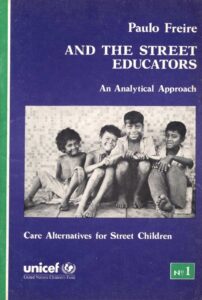
Paulo Freire and the Street Educators is a seminal 1989 UNICEF document capturing the 1985 conversations between distinguished Brazilian pedagogue Paulo Freire and street educators supporting vulnerable children in São Paulo.
Publisher
UNICEF
ISBN
95860805601
Year
1987
Pages
31
Summary
The coordinators of the Care Alternatives of the Street Children Project decided to publish this pamphlet in view of the importance of the considerations and the level of the discussions held at the “Encounter of Professor Paulo Freire with Street Educators” which took place in Sao Paulo in October 1985.
Since it is a matter which is closely linked to the children who live and work in the street, and a subject that has been studied and discussed at national and Latin American Seminars, we consider it convenient to use the texts from our files to divulge what appears to be a consensus concerning the role, aspirations and goals of these children and of the Street Educators.
Lastly, we thank Professor Paulo Freire for supporting and motivating the Street Educators’ task, as well as the educators themselves, whose participation in the development of this study was invaluable.
The obstacles to overcome are significant. However, having gained an ally with the qualities of Paulo Freire brought faith, courage, and assurance to the group.
Despite its expanse and geographic variety, overall, the region, which geographical extends from Mexico to Patagonia including the Caribbean countries, faces a severe social and economic crisis that effects the population most vulnerable strata.
During the past few years the rural-urban migration has increased, dramatically affecting the excessive growth of the marginal areas in large cities, and in particular in the capital of each country, where human groups settle in search of betterment and basic services that were already overflowing and insufficient before their arrival.
This situation is aggravated, on the one hand, by the considerable increase in the cost of food, while purchasing power experiences a rapid and gradual decrease; and on the other hand, by the threatening shadow of high unemployment rates and the number of concealed jobless or the growing insertion into the informal economy.
Although the problem attains different degrees in the various countries or regions, this almost generalized situation, severely affects the traditionally critical conditions of abandoned children, of those in high risk situation, as well as of children of the street, children on the street, or of children in conditions corresponding to any other designation used.
In view of these facts, since 1983 UNICEF has been undertaking a series of actions to support governments, the church, private institutions, and the community, in an effort to find and strengthen alternatives to rescue and foster these children. With its Regional Programme for Children in Especially Difficult Circumstances, UNICEF is promoting and developing actions aimed at increasing people’s awareness of this situation.
Time is of the essence in finding a solution to these problems and four countries, Brazil, Mexico, Colombia, and Ecuador have initiated a pioneer effort and are carrying out experimental care projects for children. These projects are consolidating and, at present, constitute models that are applicable in other countries of the region.
Contents
Presentation
Introduction
Street Children
The Street Educator's Work
The Street Educator: Endless Educational Astonishment
Qualities of the Educator
Professor Paulo Freire and the Street Educators
Extract
Most of these creatures are boys and girls between seven and seventeen years of age who live in the street and work to provide for themselves and help support their families which are usually too poor to tend to their children's basic needs. In the street, these children no longer rely on the protection of their family and community. Consequently, they become vulnerable to exploitation by others and to a variety of physical and moral dangers. Some spend all working hours in the street, and some even the nights. Thus, they have little or no access to basic services such as health and education. As a result, their perspectives of developing and securing a better future are meager. These creatures, therefore, represent an enormous waste of human potential, both for themselves and for society.
The members of the groups participating in the First Latin American Seminar on Community Alternatives for Street Children (Brasilia, 1984) pointed out the following general characteristics, as being the most common to these children:
They are premature adults seeking a means of survival in the street as a consequence of a social system that ostracizes them from society;
They permanently adopt a defensive attitude toward people in response to the physical abuse they are subjected to by the social environment that surrounds them;
They satisfy their real and basic needs in the street, where they sleep, eat, and work;
They face growing difficulties at school which result in the need to repeat school years or even to abandon their education;
They develop special abilities that enable them to survive;
They are a product of the lack of social and family affection, which adversely affects their normal development;
The street children are strong and shrewd within their own environment;
Author
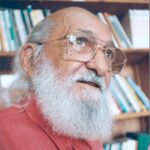
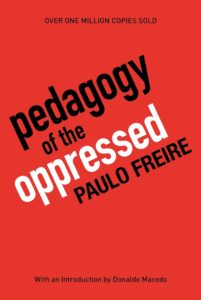
Paulo Freire (1921–1997) was a renowned Brazilian educator and philosopher whose theories fundamentally transformed critical pedagogy and adult literacy. He achieved international acclaim following the publication of his landmark 1968 book, Pedagogy of the Oppressed, which advocated for education as a tool for liberation and critical consciousness rather than passive learning.
Freire continued to expand his influential educational theories in key subsequent works, including Education for Critical Consciousness (1973), Pedagogy of Hope (1992), and Pedagogy of Freedom (1996). His innovative methods and humanitarian vision deeply shaped progressive education, social justice movements, and community empowerment initiatives worldwide throughout the twentieth century.