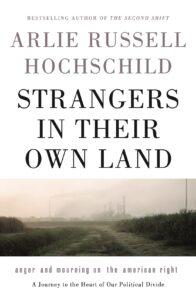
Strangers in Their Own Land Arlie Russell Hochschild
Overview
In Strangers in Their Own Land, Arlie Hochschild explores the emotional root of Tea Party conservatism in Louisiana. She introduces the “deep story”—a narrative of hard-working Americans feeling passed over by line-cutters and betrayed by the government, illuminating the deep cultural and political divide in modern America.
Publisher
The New Press
ISBN
9781620972250
Year
2016
Pages
368
Summary
In Strangers in Their Own Land, sociologist Arlie Russell Hochschild travels to the heart of Louisiana bayou country to solve a burning question: why do working-class Americans often vote for politicians whose policies deregulate corporations, weaken environmental laws, and cut the very safety nets that could help them?
Instead of dismissing her interviewees, Hochschild seeks to bridge the “empathic wall.” She introduces the concept of the “deep story”—a metaphor that captures how right-wing voters feel about their lives. In this story, people are standing patiently in a line moving toward the American Dream. They have worked hard and played by the rules. But suddenly, they see line-cutters—minorities, immigrants, refugees, women—being ushered ahead by a federal government that seems to favor everyone except the traditional working class. When the government calls them racist or privileged for feeling betrayed, it adds insult to injury.
This deep emotional narrative explains why residents living near toxic chemical spills still passionately oppose government regulation. For them, the free market represents freedom, self-reliance, and pride, while the federal government feels like a intrusive entity that undermines their community values and dishonors their sacrifice.
By shifting the focus from policy arguments to core emotional truths, Hochschild offers a compassionate, eye-opening look into America’s political divide, showing that understanding another person’s feelings is the first step toward genuine dialogue.
Contents
PART ONE: THE GREAT PARADOX
Traveling to the Heart
“One Thing Good”
The Rememberers
The Candidates
The “Least Resistant Personality”
PART TWO: THE SOCIAL TERRAIN
Industry: “The Buckle in America’s Energy Belt”
The State: Governing the Market 4,000 Feet Below
The Pulpit and the Press: “The Topic Doesn’t Come Up”
PART THREE: THE DEEP STORY AND THE PEOPLE IN IT
The Deep Story
The Team Player: Loyalty Above All
The Worshipper: Invisible Renunciation
The Cowboy: Stoicism
The Rebel: A Team Loyalist with a New Cause
PART FOUR: GOING NATIONAL
The Fires of History: The 1860s and the 1960s
Strangers No Longer: The Power of Promise
“They Say There Are Beautiful Trees”
Extract
When I began Strangers in Their Own Land five years ago, I was becoming alarmed at the increasingly hostile split in our nation between two political camps. To many on the left, the Republican Party and Fox News seemed intent on dismantling much of the federal government, cutting help to the poor, and increasing the power and money of an already powerful and rich top 1 percent. To many on the right, that government itself was a power-amassing elite, creating bogus causes to increase its control and handing out easy money in return for loyal Democratic votes. Since that time both parties have split their seams and Donald Trump has burst onto the scene, quickening the pulse of American political life. I had some understanding of the liberal left camp, I thought, but what was happening on the right?
Most people who ask this question come at it from a political perspective. And while I have my views too, as a sociologist I had a keen interest in how life feels to people on the right—that is, in the emotion that underlies politics. To understand their emotions, I had to imagine myself into their shoes. Trying this, I came upon their "deep story," a narrative as felt.
The subject of politics was a big departure for me but my close-up approach was not. In a previous book, The Second Shift, I focused on the abiding question of how parents guard care and time for life at home when both work outside it. I found myself sitting on kitchen floors in the homes of working families, watching to see which parent a child called for, which parent answered the phone, the relative gratitude each partner felt to the other.
Author
Arlie Russell Hochschild is a renowned American sociologist and professor emeritus at UC Berkeley. Famous for pioneering the sociology of emotion, her groundbreaking books include The Managed Heart, The Second Shift, The Time Bind, and Strangers in Their Own Land, a finalist for the National Book Award.